Replacing a data cabinet?
Keep what works. Relabel everything you keep.
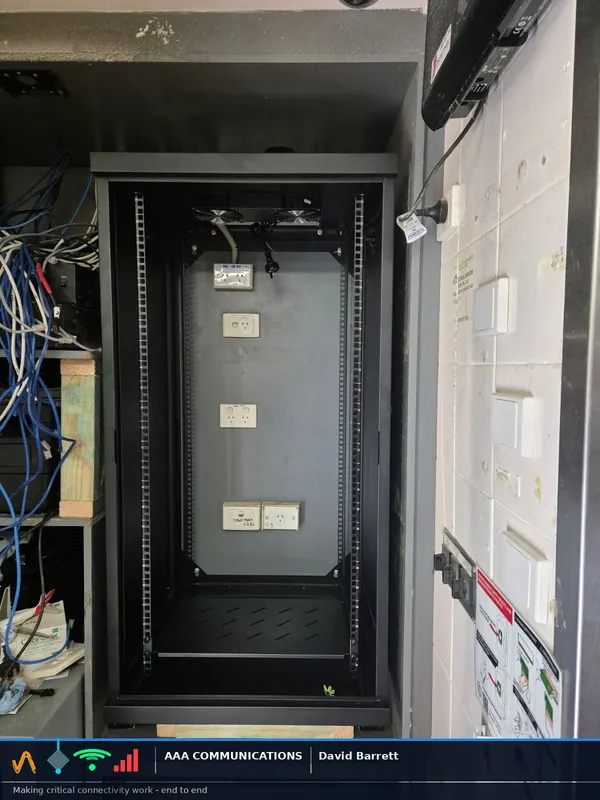
This cabinet is brand new. The felt pen on those outlets is years old, and it came from someone else's job. Here is what to keep, what to redo, and the handover that lets the next technician trace every outlet, even the ones hidden behind the gear.
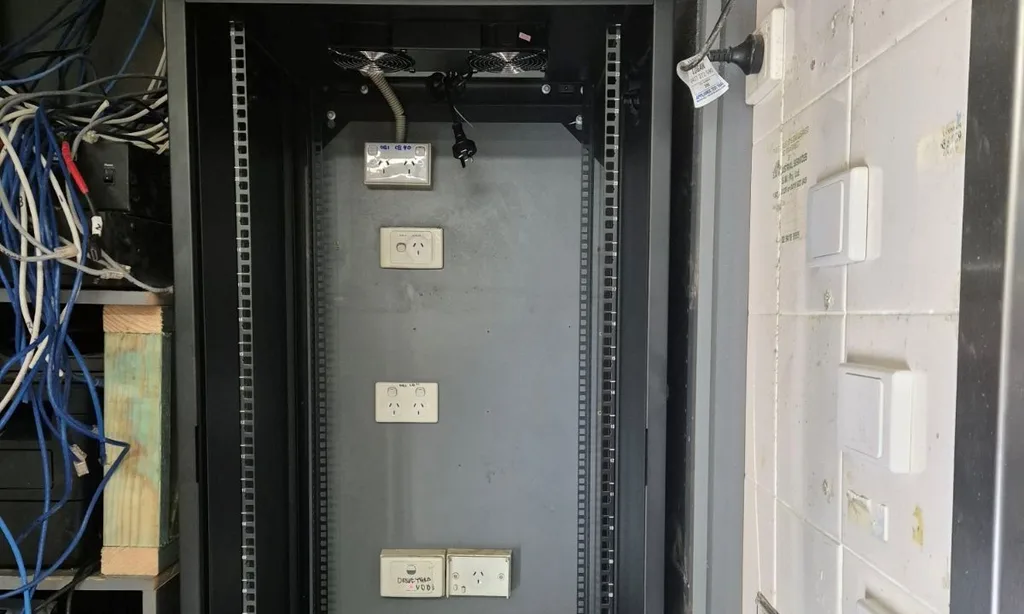
Actual field photograph. Brownfield cabinet remediation, Australia, 2026. The cabinet is new. The handwriting on the outlets came with them.
When you move equipment into a new data cabinet, keep what still works, but don't carry the old labels across. Relabel every power outlet and port with printed labels to AS 3085.1, put the same ID on the plug end, and hand over a schedule that maps each outlet to its device and circuit, with photos of the back panel before the gear goes in. Until all of that is in the handover pack, the job isn't finished.
The job
The cabinet is new. The handwriting is years old.
This was a brownfield remediation. The customer needed a different-sized data cabinet, so a new one went in and everything moved across to it. Not everything was replaced, and it shouldn't have been. Some of it still worked, so it stayed.
The power outlets on the back panel stayed too. Every one of them carried felt-pen labels from an earlier job. None of that writing was ours. Everything moved across in one cutover window, with no second shutdown, and the old shortcuts were redone properly as each item came across.
Keep or redo
Still works is not the same as still right.
Remediation budgets are real. Customers keep switches, UPS units and outlets that still do their job, and they're right to. The mistake is carrying the old records and labels across with them, unchecked.
| Item | Keep it when | Redo it when |
|---|---|---|
| Equipment | It tests clean and fits the new cabinet | It's end of life, or it won't fit the cabinet depth |
| Power outlets | They work and you can name the circuit feeding each one | Nobody can say which circuit feeds which outlet |
| Labels | They're printed and match what is actually patched | They're handwritten, faded, or don't match the patching |
| Patch leads | Right length, tested, labelled at both ends | Wrong length, unlabelled, or coiled slack |
| Records | The schedule has been checked against the cabinet | Nobody has checked it against what is installed |
Replacing a switch at the same time? Measure first. A same-brand replacement isn't guaranteed to fit the cabinet it's going into.
The question from the thread
The outlets you won't see again.
When the photo went up on LinkedIn, Max Migliore asked the question every IT manager should ask about it.
"I agree, but what good are labels when you can't access or even see the outlets at the back of all the equipment once installed? Poor design and implementation."
Massimiliano (Max) Migliore, Principal Consultant, All Digital
He's right. A label on an outlet only helps while you can see the outlet. Once a switch, a patch panel and a UPS are mounted in front of that back panel, the label is out of sight, and the next technician is back to pulling plugs to work out what feeds what.
Label it so you can trace it without seeing it.
And where the design buries outlets that need to be reached, fixing the layout is part of the remediation, not an extra.
What it costs
Half a day tracing, port by port.
"Mine was a comms cabinet three years into a tenancy. Every label was faded handwriting from the original build, and none of it matched what was patched. We spent half a day tracing it port by port before touching anything."
That half day is the cost of a label nobody replaced. On a live site it's also a risk window. Every plug pulled to identify a circuit is a chance to drop something that matters.
Uptime Institute's 2025 outage analysis reported that 85% of human-error outages stem from staff not following procedures, or from flaws in the procedures themselves. A technician can't follow a cabinet record that doesn't exist.
The handover
What a finished cabinet handover contains.
Before the installer leaves site, the handover pack should include:
- Printed labels on every outlet, port and patch lead, to AS 3085.1
- The same ID on each power plug as on the outlet it's plugged into
- A port and cable schedule that matches what is actually patched
- An outlet to device to circuit map
- Test results for the links that were moved or re-terminated
- Photos of the back panel before fit-out, and the front after
AS 3085.1:2022 sets the basic requirements for identifying the components of a cabling system and recording installation details. It applies to the cabling system as it's installed, so kept components should be labelled to the same standard as new ones.
If any of these is missing, the job isn't finished and sign-off should wait. The 2-minute enclosure check covers what to look at before you sign.
From the thread, real voices
One photo. One fair challenge.
The post reached over 11,000 people. The comment that mattered most was the one that pushed back.
I agree, but what good are labels when you can't access or even see the outlets at the back of all the equipment once installed? Poor design and implementation.
Massimiliano (Max) Migliore Fair challenge, Max. Outlet labels alone aren't enough. That's why the standard is a printed label at the outlet, the same ID on the plug end, and a schedule that maps outlet to device to circuit. If you can't see the outlet, you can still trace it from the paperwork. Where the design buries them, fixing the layout is part of the remediation.
Best part of a remediation is the handover. Everything lands in the new cabinet, and the paperwork says what's what. What's the worst "temporary" label you've had to trace back?
Michael Barrett Mine was a comms cabinet three years into a tenancy. Every label was faded handwriting from the original build, and none of it matched what was patched. We spent half a day tracing it port by port before touching anything.
Our position
Keep what works. Fix what doesn't. Document all of it.
AAA Communications is a Sydney-based network infrastructure contractor that has installed, tested and documented cabling on live sites since 1992, for office, branch, retail and industrial clients across Australia. That's 34 years on live networks, and 350 enclosures dressed and labelled on sites another installer had already worked on.
On at least 4 in 10 jobs we're called into, we find installation gaps that need some rework. Most of them are in the record, not the hardware. Brownfield cabling remediation is core work for us, and when the concern is the whole site rather than one cabinet, a Layer 1 Network Audit maps what is actually installed.
An agreed cabinet and port count. A connection map and printed labels. Agreed patch leads and cable organisation. Tests of the agreed links. A port schedule and handover photos.
The price range covers a tightly defined small cabinet, with a final fixed quote after a scope check. New runs, switches and major repairs are extra. See what Cabinet Reset includes.
Not ready yet? Send 3 photos. Get a free cabinet review. Our target is a reply the same day the photos arrive.
Related reading: who owns the risk in that cabinet, why as-built documentation has to be checked against the install, and rebuilding the record when the comms room knowledge walks out.
When you remediate, what do you inherit, and what do you hand over?
Common questions
We didn't write those labels. We're the ones fixing them.