Clearing an old comms cabinet?
Get a written do-not-touch list before anyone pulls a cable.
In April 2020 a technician cleared a cabinet of retired gear and took Cloudflare's dashboard and API offline for 4 hours 21 minutes. The patch panel in that cabinet carried every external link from the site. This is the 2-hour audit that stops the same thing happening in your comms room.
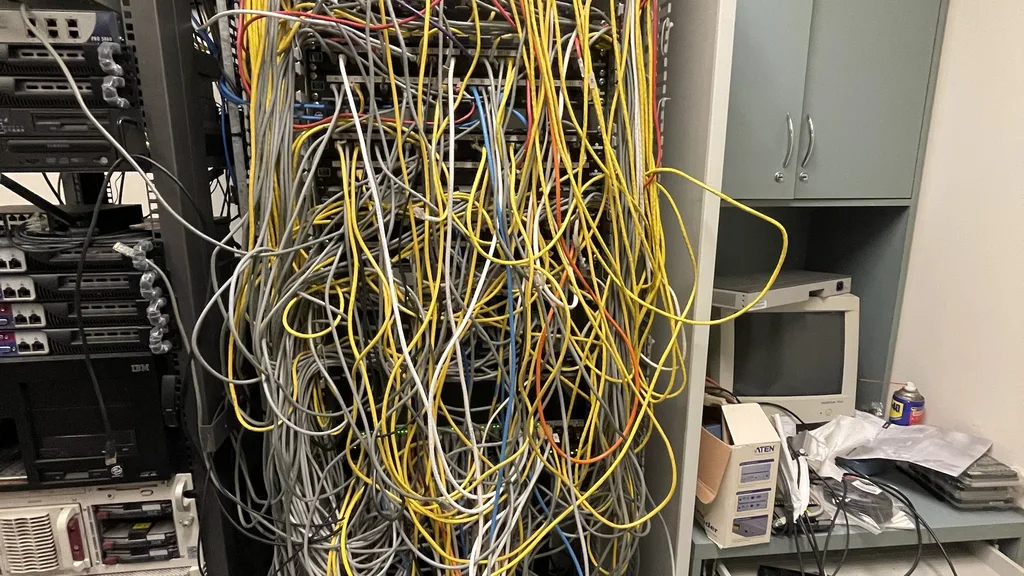
Actual field photograph. A live comms room cabinet on an AAA site visit, Australia, 2026. The only sign of what is still live is a few green lights.
Short answer: before you decommission a comms cabinet, trace every link in it to its far end, tag each one live or retired, label what stays and put the do-not-touch list in writing. Only then does anything get unplugged.
AAA Communications is a Sydney-based network cabling and infrastructure company. We have worked on live office, branch, retail and industrial networks since 1992 and deliver nationally. Clearing old cabinets is routine work for us, and the audit always comes first.
The case
Three minutes of tidy-up. Five hours to get it back.
On 15 April 2020, Cloudflare ran planned maintenance at one of its two core data centres. The job looked simple: retire a cabinet of old, inactive equipment. Technicians were told to remove everything in it.
That cabinet also held a patch panel. It carried every external link from that site to the rest of Cloudflare's network. Diverse providers. Diverse routes. One panel. Over the space of three minutes, those cables came out with everything else.
The repair was not the slow part. Working out which cables mattered was. Cloudflare's own post-mortem says the team lost valuable time identifying the critical cables for the technicians on site, because nothing was labelled for fast identification.
Cloudflare published the post-mortem themselves. Their fix list is short:
- Spread external links across the facility, not through one patch panel.
- Label cables and panels so the critical ones can be found fast.
- Spell out in writing what must not be touched before anyone starts.
No software fault. No attack. A patch panel and a set of unlabelled cables. Source: Cloudflare Dashboard and API Outage on April 15, 2020.
Why it matters now
Six years on, more of your business runs through that panel.
The cause hasn't changed. What has changed is how much rides on it. Cloud apps, Wi-Fi 7 access points, cameras and door access all land on patch panels like these. The cabinets that get cleared out are usually the oldest ones on site, with the least documentation and the most changes since anyone last wrote anything down.
We see the same pattern behind walls and under floors. Each trade leaves something behind and nobody updates the record. Our piece on 14 cable types in one undocumented wall shows where that ends up, and a network documentation audit explains how far the drawings usually drift from what is installed.
Before you start
Three checks before anyone touches a cabinet.
If a cabinet fails any of these, it doesn't get cleared until it has been traced.
"In a cabinet like this, the only thing telling you what's live is a few green lights."
The audit
Pre-decommission trace and label audit, A$1,500 ex GST.
We don't touch a cabinet until it is traced. On every remediation, upgrade and comms room decommission, the audit comes first: what's live, what's retired, what's labelled, and what nobody touches. Then the plan. Then the work.
| What it covers | One comms room cabinet, up to 3 uplinks of any type: copper, fibre or cellular |
|---|---|
| What we do | Trace every link to its far end, tag live vs retired, label what matters and write the do-not-touch list |
| Time on site | Two technicians, about 2 hours, out of hours or before your team arrives |
| Disruption | Nothing is disconnected during the audit |
| What you provide | After-hours access and any existing plans you have |
| What you get | A full written report within 5 business days |
| Price | A$1,500 ex GST |
| How the price is set | Send a photo of the back of the cabinet. If it fits the standard job, the price is confirmed before we book and won't change on the day |
| Scoped separately | Failover testing with your team on hand, the removal, a cabinet reset, the go-live afterwards, and the tested outlet map described below |
Send a photo of the back of the cabinet. If it fits the standard job (one cabinet, up to 3 uplinks), A$1,500 ex GST is confirmed and won't change on the day. If it looks bigger, we do a free site assessment first and quote the full job before any work starts.
We have run more than 1,000 of these trace-and-label jobs over 34 years. On every cabinet replacement, upgrade and remediation, it is the standard first step, and we have dressed and labelled 350 enclosures along the way. It's why unplanned outages on our jobs are rare. The ones we hear about happen where that step was skipped.
Once the report is in, the next step depends on the cabinet. If the gear is staying and the cabinet needs sorting, Cabinet Reset is the defined package for that. If you are replacing the cabinet and keeping some equipment, here is what to keep, what to relabel and what the handover should contain. If the concern is the whole site rather than one cabinet, start with a Layer 1 Network Audit. And if you are counting on a backup link that nobody has tested, read why your redundant network has never actually failed over.
If someone started clearing your oldest cabinet tomorrow, would anything stop them pulling a live link?
What comes next
The trace is step one, not the whole job.
The audit tells you what is safe to pull. The next step tells you what every remaining outlet is for, and whether it can carry what you plan to put on it.
We trace each outlet to its port, document which application and which department uses it, and Fluke test the cable and port so you know it will carry the load you expect next, including the PoE power new access points, cameras and phones need. That work is scoped separately from the A$1,500 audit, because its size depends on how many outlets you have.
That map is what the next decisions are built on: VLANs that keep finance, cameras and guest Wi-Fi apart, an SD-WAN rollout that knows what each site actually runs, and the segmentation that cyber resilience depends on. Skip the trace and every one of those steps is designed on guesswork. More on that in physical network constraints on cyber resilience.
From the thread
Engineers recognised this cabinet straight away.
When this story went up on LinkedIn it reached 7,407 people, mostly network and systems engineers. These are the points the thread made, not the quotes.
Common questions