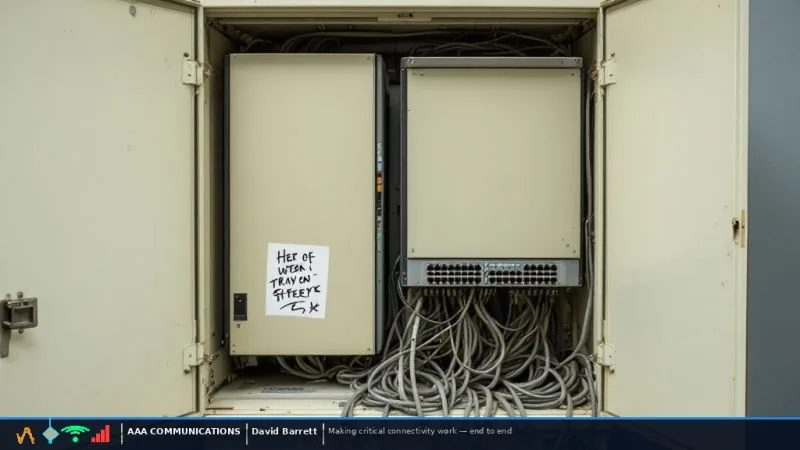
The undocumented comms room. A handwritten note is the only record that survived the last handover.
Your comms room is run by someone who left three years ago. They took everything with them, and a handover document was never going to bring it back.
The undocumented comms room. A handwritten note is the only record that survived the last handover.
Someone knew what every cable did. Then they left. That knowledge did not transfer. It evaporated.
The handover that never happened
Someone knew which unlabelled patch cord fed the server room UPS. They knew which run went to the access point on level three, and which port nobody was allowed to touch. It all lived in one head. When that person left, none of it transferred to a document.
What replaced it was institutional habit. Fingers crossed during planned changes. A new contractor who assumed the labels meant something. An MSP handover that took three weeks longer than quoted, because nobody could tell them what was live and what was legacy.
Every brownfield site has a version of this. The record that should answer the question is a person, not a document. The day that person walks out the door, the site becomes something nobody can fully explain.
The cost
When a physical layer fault lands in an undocumented environment, fault-finding does not stretch by minutes. It stretches by hours. Sometimes days. Every decision waits on someone tracing a cable by hand, because the record that should answer the question does not exist.
ISO/IEC 11801 requires documentation at the point of installation. It does not require anyone to maintain it after handover. Nobody comes back to check. The as-builts start ageing out the moment the first undocumented change goes in, and from that point the network and the paperwork describe two different sites.
Why it happens
Every brownfield audit surfaces the same finding. Three different decades made a series of reasonable decisions that no longer make collective sense together. None of them were wrong on the day. The sum of them is a site nobody fully understands.
This is where the physical layer becomes the problem. It is where the management failure goes quiet and load-bearing. Internal standards, and someone who actually cares above the team, are what make documentation happen or not happen. When neither is in place, the gap does not announce itself. It waits for an outage.
The physical layer is where the management failure goes quiet and load-bearing.
What the field said
The post drew network engineers, architects and infrastructure documentation specialists from Cisco, BT Group, Fortinet, Ericsson, Nokia, Telstra, Vodafone, Openreach and Arista. The thread landed on a single point: documentation survival is an organisational problem wearing technical clothing.
That tracks with what I see on audits, Shane. There are two different problems hiding in one. Documentation surviving the handover, and documentation surviving contact with a new provider. The second one is organisational, not technical. Once the contract is signed, nobody on the incoming side has a reason to ask the outgoing site contact anything. The knowledge is sitting right there, and the process is built to walk past it.
It is a management problem, not an engineering problem. Without internal standards and methods for documentation, everyone will do their best if they can be bothered. If no one cares above them, then it will not happen. There are no external standards available that really apply and work across technology and teams. Defining methods and standards across information sets covering inventory, connectivity, capacity, build orders, schematics and audit points is not simple when the starting points are unknown and skills vary.
Agreed, David, and it starts as a management problem. Internal standards, and someone who actually cares above the team, are what make documentation happen or not. Where it becomes my problem is the physical layer, because that is where the management failure goes quiet and load-bearing.
This can only really be produced by in-house ownership.
Agreed, Andrew. Ownership is what keeps it alive, and when it walks out the door this is exactly where you end up. An audit does not bring the knowledge back, it gives the next owner a baseline they can actually hold.
Happens all the time and keeps us in business.
Ha, too true, Graham. Job security written in undocumented patch leads. Every site someone fixed with good intentions and never wrote down is work for the rest of us.
Our position
We have been validating physical infrastructure on live networks since 1992. You cannot interview someone who left three years ago. You cannot trust labels that were never verified. The only reliable record is the one built by tracing the infrastructure as it physically exists today, port by port and run by run, and documenting it to standard.
That is what a Layer 1 network audit produces. Not a sales pitch. A current, verified map of what is actually there, what is live, what is legacy, and where the risk sits. The same physical method underpins our brownfield cabling and remediation work, where the audit is the first thing that happens, not the last.
Physical trace of the installed infrastructure, port by port and run by run. Identification of live versus legacy. Verified labelling and pathway records. Certification against current standards. As-built documentation that matches reality. One accountable partner, nationwide, on live business-critical networks.
The handover document answered one question, on one day, in the words of someone who has since left. The only record you can rely on now is the one that reflects the site as it physically stands today. You build that in a planned audit, on your terms, or you reconstruct it under pressure during the next outage.
Common questions
Related reading
This article sits alongside two others documenting the same blind spot from different angles:
Before the knowledge walks out, or after it already has, a Layer 1 audit rebuilds the record your team can rely on.
Book a Layer 1 Audit
I have seen this firsthand. The MSP simply does not bother to read it, and there will be other people who assisted, who are simply not spoken to. They like all their managed systems to be the same. This is common practice with outsourced providers.