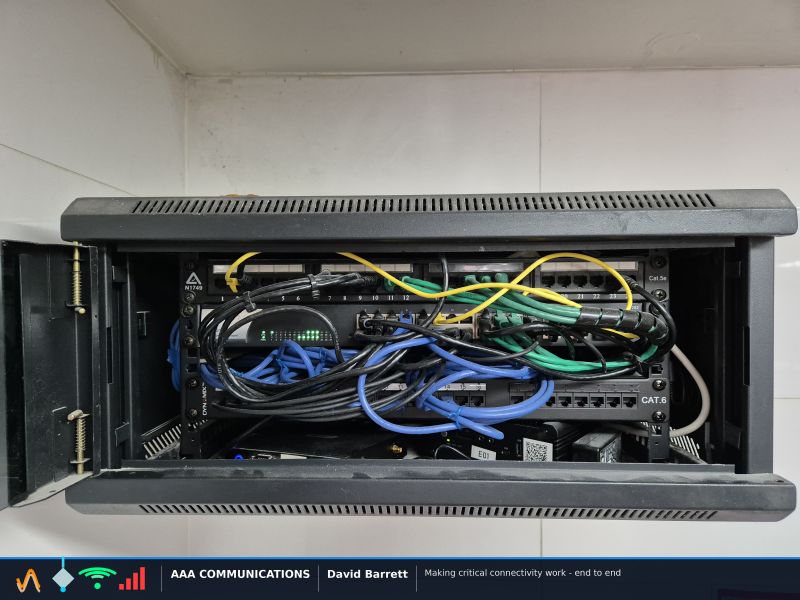
Photo from the original LinkedIn thread. Commercial site cabinet, unlabelled Cat5e and Cat6 runs from years of unrecorded changes.
AAA Communications is a Sydney-based Layer 1 network testing and structured cabling company, Telstra Partner since 1992. From a LinkedIn thread on a real commercial cabinet: the accountability gap that sits between IT, facilities, and whoever did the work last.
Photo from the original LinkedIn thread. Commercial site cabinet, unlabelled Cat5e and Cat6 runs from years of unrecorded changes.
In most Australian businesses, no single person owns the complete record of who touched a network cabinet and when. ACMA registration governs who is legally allowed to do cabling work. It does not require anyone to document what they did, or hand that record to the next person. That gap is where risk quietly accumulates, and it sits between IT and facilities, owned by neither.
Field observation
A contractor gets called in on a fault at a commercial site. The internal IT team has already replaced several switches trying to chase it down. When the cabinet finally gets opened, it's not a switch problem. It's years of patching, several different hands, no labelling, no as-built record, the kind of mess that only shows up once something forces the door open.
That's exactly what happened to Elmar Schieren, who posted his own photo of the rack under the original post: a major commercial site, rack and network managed by the client's internal IT department, called in to help with a fault after several switch replacements hadn't fixed it.
"That's the bit that should worry any IT exec reading this thread. It's not that nobody knew, you told them and they chose not to act. That's not a technical risk anymore, that's a documented decision someone made to leave it. If that cabinet ever causes an outage or a compliance issue down the track, there's now a clear paper trail of who was told and when."David Barrett, reply to Elmar Schieren
Ownership
Kelvyn H., Director at Exeid Support & Exeid IT, put the structural problem in one line: IT owns the switch, facilities owns the cabinet, a contractor owns the last change made, and nobody owns the complete record. Every move, addition or change ends with labelling and an updated port schedule, or it doesn't, and the debt just accumulates one patch lead at a time.
That's the pattern behind almost every messy cabinet: not one bad actor, but a chain of people each doing their own job correctly in isolation, with nobody responsible for the handover between them.
Compliance vs ownership
Robin Stenzel raised the regulatory reality directly: once cabling is outside the wall, the Wiring Rules carry little legal weight. S009/008 applies instead, and it's effectively unregulated in practice. ACMA has no mandatory reporting path. No regulator is coming to check the work.
"If nobody's checking, the only thing standing between a compliant cabinet and a liability is whoever did the work last. Compliance gives you a document. It doesn't tell you who gets called at 8am Monday."David Barrett, reply to Robin Stenzel
That's the distinction IT executives need to sit with. A compliant install and an owned install are not the same thing. One is a document. The other is a name.
Market reality
Mark Roberts, Managing Director at MR Communications, named the market failure plainly: most businesses have no idea who's actually licensed to do the work, and ACMA's oversight has become largely theoretical. Nobody's shopping for a licence. They're shopping for a number on a page.
Craig Symington made the same point from the delivery side: circuit numbers get you to a cabinet, not to which of forty identical blue leads is actually carrying a fault. When price is the deciding factor, documentation and management are exactly what gets cut, because it's not what most quotes are asked to budget for.
Emerging standards
David Pearce flagged that the latest BS7671 update in the UK now covers load current heating in PoE-carrying data cables, treating it as a genuine safety consideration, not just an IT admin problem. A cabinet full of bundled PoE runs isn't just visually messy anymore. It's a thermal load nobody's monitoring, and the standards are starting to say so explicitly.
The practical question for any IT exec: does facilities or IT own that risk before the standard catches up and forces the question? Right now, it's sitting in the same gap as everything else in this cabinet, assumed to be someone else's problem.
What closes the gap
Robin Stenzel offered a genuinely practical mechanism: make photo evidence of prior work a condition of payment, not just a nice-to-have. It forces a standard onto the record before the invoice clears.
It's a real improvement. It's also not the whole answer. A handover photo tells you the state of the cabinet on the day it was signed off. It doesn't tell you who's responsible when someone else opens it again in three years and adds to it without updating anything. Evidence at handover and a named owner afterwards are two different requirements, and most contracts today ask for neither.
What the thread confirmed
The comment thread drew responses from cabling and infrastructure professionals. Each raised a different piece of the same accountability gap.
Our position
The original question was who owns the risk sitting inside that cabinet: the IT manager, or the facilities lease holder. The honest answer in most businesses is nobody, by default, until something forces the question. The fix isn't more compliance paperwork. It's making as-built documentation a contractual deliverable at handover, and naming who owns the record after that. Everything else is just hoping the next person who opens that door writes it down. Our structured cabling engagements build that named ownership into the handover pack from day one.
The cheapest moment to settle ownership is at sign-off. The 2-minute enclosure check covers the three questions to ask before anyone signs.
Reviewing a quote right now and want a second set of eyes on documentation and ownership before you sign? Our free quote and scope review checks for exactly this gap.
Undocumented ownership and an unopened cabinet are the same gap from two angles. See the cabinet nobody opened.
Common questions