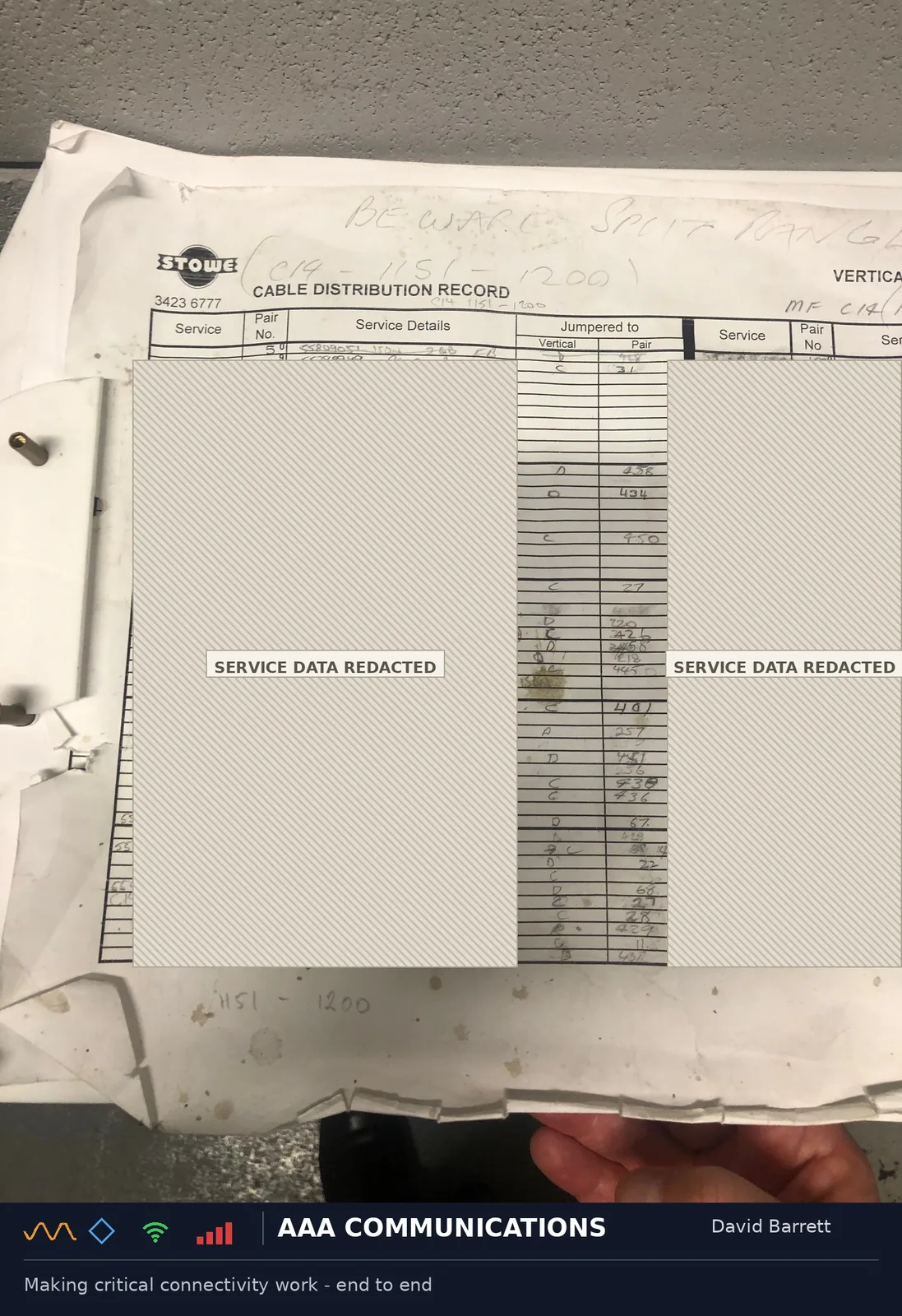
Physical verification against the record. This is the step a design drawing can't do for you.
A cable audit that looked better than most ever do. Every cable numbered, every port labelled, cross-referenced to a spreadsheet detailed enough to pass for someone's PhD. A technician checked three cables against it before trusting the rest. Two were wrong.
Physical verification against the record. This is the step a design drawing can't do for you.
A cable audit landed on a technician's desk looking better than most ever do. Every cable numbered. Every port labelled. He followed three cables himself before he trusted a word of it. Two were wrong.
What happened
The spreadsheet hadn't been built from what was actually pulled. It had been built from what was meant to be installed. Nobody had ever gone back and checked the two against each other. That gap cost the client two days chasing faults that, on paper, didn't exist.
This is the failure mode nobody plans for. Not missing documentation, bad documentation that looks complete. A network engineer we spoke with, who works as a data centre technician and fibre optic engineer, put it plainly in the discussion that followed: incorrect documentation can be worse than no documentation at all, because it creates false confidence.
No documentation prompts caution, technicians know to verify before they trust it. Documentation that looks complete removes that caution entirely. Technicians stop questioning the map and start troubleshooting a network that only exists on paper.
The distinction that gets skipped
The distinction sounds obvious once it's said out loud. In practice, it's the gap most handovers quietly skip. A design gets drawn up before a single cable is pulled. Somewhere between that drawing and the day the cabinet door gets locked, changes happen: a different run, a rerouted path, a substituted part, a port reassigned on site because the original plan didn't survive contact with the building. The design intent stays on file exactly as drawn. Nothing forces it to catch up with what actually got installed.
“As-built” is supposed to be the record that catches up. Too often it's just the design document renamed.
What actually closes the gap
The fix isn't more documentation. It's a specific, separate step: someone walks the site and confirms, outlet by outlet, patch-panel port by patch-panel port, switch port by switch port, service assignment by service assignment, that what's on the page matches what's actually terminated and running. Not sampled. Not spot-checked against a subset that looked representative. Checked.
If it doesn't match, the as-built gets corrected before handover. It doesn't get noted as an exception and left for the next person to discover during an outage. This walk-and-verify step is exactly what our Layer 1 Network Audit treats as its own accountable deliverable, not a formality attached to accepting the paperwork.
Every outlet, patch-panel port, switch port, and service assignment checked against what's installed, as its own accountable step, separate from accepting the paperwork. Mismatches corrected before handover, not logged as an exception for the next person to find.
That last part matters more than it sounds like it should. An exception noted and left is exactly how the two-day fault-chase happened in the first place. The spreadsheet wasn't fraudulent. It was reasonable, on the day it was built, from the information available at the time. It just never got checked against reality before it was trusted.
If the cabinet itself and its documentation have already drifted apart and need fixing, not just re-checking, Cabinet Reset is a defined package to bring the physical cabinet and its handover documentation back into alignment.
Why this came up at all
The conversation started somewhere else entirely, a debate about whether a horizontal cable manager in a rack build was doing useful work or just eating rack space. The initial challenge was reasonable: a patch panel sitting close to its switch with short cords looks tidier and easier to trace. The counter-argument, and the one that held up, was that short cords remove flexibility the moment a port needs reassigning, a cable needs replacing, or the environment includes frequent cross-patching.
Neither position was right in isolation. The right layout depends entirely on how the site actually gets operated, not on how it photographs on handover day.
That's the same principle underneath the documentation gap. A rack that looks clean and a spreadsheet that looks complete both invite the same mistake: judging the artefact instead of testing it against how the thing actually gets used and maintained.
The cabinet that looks right and the record that reads right both deserve the same question: has anyone actually checked, or does it just look checked?
The takeaway
An as-built should document the network that physically exists, not the network everyone assumes exists. Design intent is the starting point. Field verification, run as its own accountable step, is what turns a plausible document into a trustworthy one.
If your last handover documentation was accepted because it matched the design rather than because someone walked the site and checked it against what's actually there, that gap is still open. It stays open until something forces it: usually a fault, usually at the worst time.
Kept equipment needs the same check. See what to keep and relabel when you replace a data cabinet.
Common questions
Before you sign off the install itself, run the 2-minute enclosure check: three yes or no questions at the open door.
Fitting out a boardroom or VC room? The boardroom AV cabling checklist covers the 8 checks to run before the walls close.
We validate what's actually installed against what's on record, outlet by outlet, port by port, before it becomes someone else's two-day fault-chase.
Read our documentation audit approach