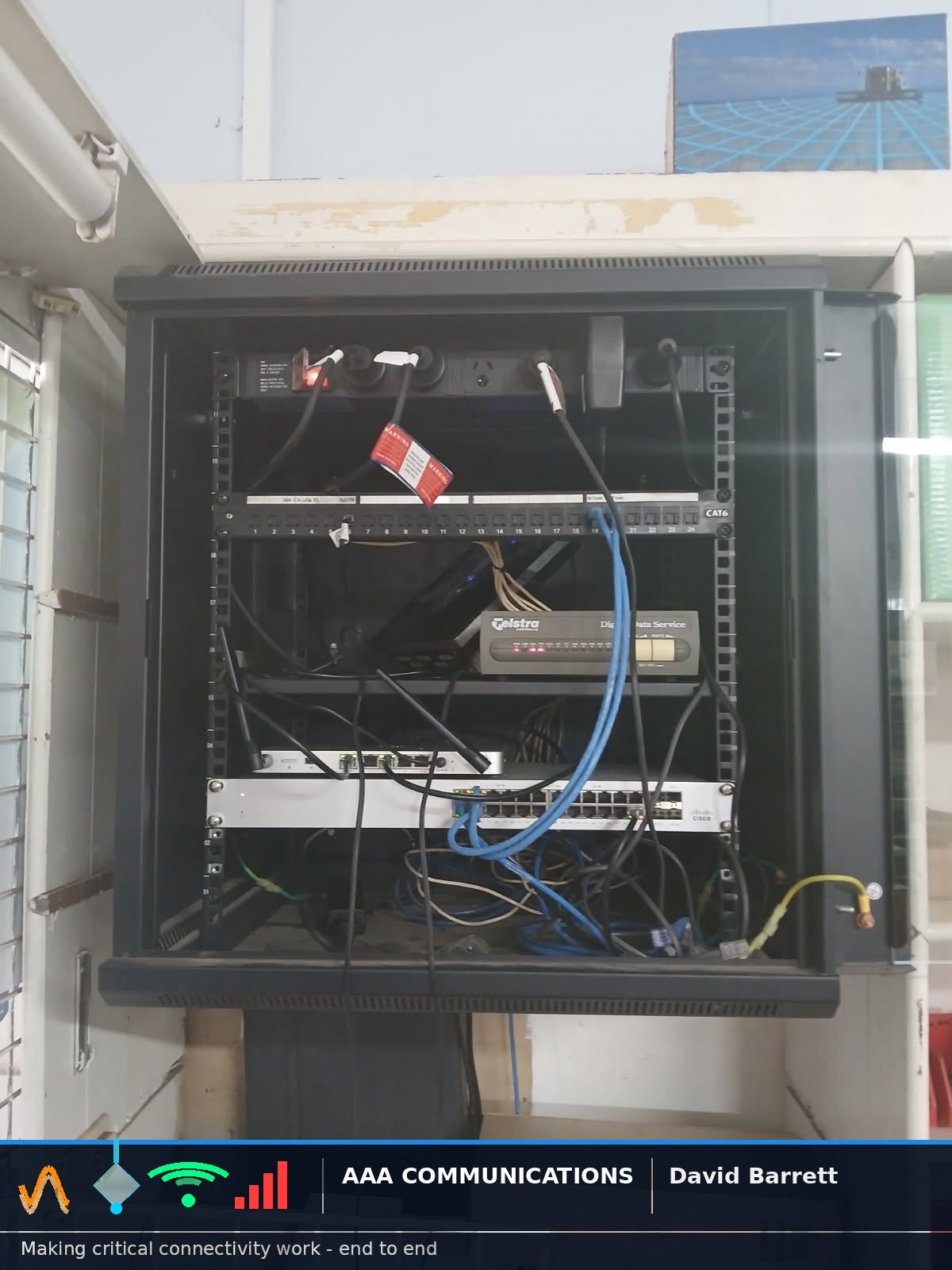
A live site cabinet. Carrier NTU, a switch, a patch panel and three years of cabling nobody planned. The framed print on top is the giveaway: nobody thinks of this as infrastructure any more.
Your carrier's responsibility stops at the NTU. Everything after it, the switch, the patch leads, the labelling and the earthing, needs a name against it. Most cabinets don't have one. Here's how to find out who owns yours before an outage does.
A live site cabinet. Carrier NTU, a switch, a patch panel and three years of cabling nobody planned. The framed print on top is the giveaway: nobody thinks of this as infrastructure any more.
Your NTU sits in that cabinet because the carrier put it there. Nobody decided what happens around it after that. That is the gap. Not a knowledge gap, an ownership gap.
The short answer
The carrier owns everything up to and including the NTU. Everything on your side of it, the switch, the patch leads, the labelling and the earthing, is yours. If nobody on your team is named as responsible for it, nobody maintains it, and you find that out in the first ten minutes of an outage.
In practice, everything after the NTU belongs to whoever touched it last. The switch somebody added. The cable somebody ran. The labelling nobody did. Which means it belongs to nobody.
Carriers are specific about this space for a reason. Ventilation, front clearance, lockability when other active gear shares the enclosure: these are conditions of service, not suggestions. A cabinet that started life housing one NTU and quietly became home to a switch and a rat's nest of patch leads has usually drifted well outside the envelope it was designed for. Heat builds. Nobody notices until something drops out on the hottest day of the year, and the fault call takes three times longer than it should because the technician is tracing cable by hand instead of reading a label.
A cabinet nobody can read costs you the hour it takes to find out whose fault it actually is. Not because the fault is hard. Because nobody was ever made responsible for knowing.
How the gap opens up
Three causes came up again and again from engineers, consultants and field techs who had seen this cabinet on their own sites.
None of this is laziness, whatever the comments section says. It is what happens by default when nobody has been given the job of saying no.
"The carrier's responsibility ends at the NTU. Yours starts there, whether anyone wrote it down or not."
The method
The most useful reply on the thread was not an opinion. It was a method, from a security consultant who had run into exactly this at a law firm.
He drew up a list of every item in the environment and asked each person on the IT team two questions: which of these are you responsible for, and is there anything here I've missed?
Then he compared the answers. People were good at naming what was specifically theirs. Almost everything nobody had claimed was assumed to belong to one person, the head networking engineer. He was a nice guy who never said no to anyone, so he had become the default owner of every unclaimed task.
His advice to the IT director: give that engineer a pay rise, and teach everyone else to stop going to him first. A week later the engineer had a new laptop, "right out of the blue." The next job was teaching him to say "you should look again, this is not my problem."
The fix was not technical. It made an invisible allocation visible, then gave one person permission to push back. You can run the same exercise on a single cabinet in an afternoon.
The objection
Fair question, and it came up more than once. A rough-looking cabinet can pass every test on the day it is commissioned.
But the problem was never cosmetic. It is serviceability. A network that works today but takes three hours to fault-find in twelve months, because the tech who built it has moved on and nothing was written down, is not working. It just hasn't broken yet.
A former service engineer who spent years building fibre and street cabinets made the same point from the other side. When every cabinet is built identically, the engineer on a 4am fault call doesn't have to think. They know where everything is before they open the door. That is the difference between a ten-minute fix and an hour of tracing cable by hand.
At quote stage: an itemised equipment list costed per line, the install hours quoted and the hourly rate behind them, and three contactable references with photos of finished work. A cheap quote usually means fewer hours on site. Our free Before You Approve That Quote checklist walks through it.
At handover: a label register, a cable schedule, as-built drawings showing where every run terminates, and certification test results for every link.
Messy cabling is an inconvenience. Poor earthing is a liability. In a cabinet shared with active equipment, a bad earth or bonding connection is a safety and compliance problem, not a slower fault call. Check earthing and bonding against AS/CA S009 on every cabinet audit. Never assume it is fine because the cabling looks neat.
What the thread confirmed
The post drew network engineers, security consultants, FTTP planners and infrastructure founders from Australia, the UK, New Zealand and the US. More than 20,000 impressions and 26 comments, almost no ad reach. Every voice described the same gap from a different angle. These are the insights, not the quotes.
From the thread · real voices
The strongest replies added the part the post left out. A few pushed back hard enough to sharpen it. Here is the exchange that mattered.
Good pickup, and no, not always. In our world it's usually whoever's contract says NTU-to-wall-jack, which on paper is the carrier's cabinet and everyone else's problem the second something's plugged in beside it. Fault-finding falls to whoever documented it last, which on that job was nobody. That's the bit that costs the hour.
Ownership can certainly be an overlooked concept. I was consulting at a law firm and noticed this appeared to be an issue. I came up with a list of items and asked each of the IT team (about 8 people) who was responsible for each item, and were there any items I missed. People were pretty good at picking out the items they were specifically responsible for, and most everything else was felt to be the responsibility of the head networking guy. Nice guy. He never said no to anyone, so he became the dumpster for all tasks.
Lack of accountability and ownership is a real problem, most notably after multiple M&As. Additionally, carrier gear that is in the rack is often abandoned or left there by the carrier when the last customer left.
Both of those are real and worse than most people realise. M&A leaves behind two networks that were never meant to share a cabinet, and carrier kit nobody decommissioned becomes invisible infrastructure, still powered, still occupying space, answerable to nobody. That's the ownership gap showing up at the corporate level instead of the site level.
It's usually more than likely the cheapest quote, which only allows the technician one whole hour to install. How many people actually validate why quotes are cheaper or dearer than others? Here's a clue. 1) What is the total equipment cost, itemised per line? 2) How many hours have you quoted for, and at what hourly rate? 3) Please supply three contactable references and installation photos of your finished work.
Good list, worth adding a fourth: ask for the as-built documentation, not just install photos. Photos prove it worked on the day. A label register and cable schedule prove it'll still make sense in three years when the tech who ran it has moved on. Your one-hour quote and my undocumented cabinet are the same corner being cut, just showing up at opposite ends of the job.
All I see is these pics all over the internet about cosmetic stuff. If the equipment is properly configured, cosmetic means nothing. If you make it pretty on the outside but the network does not work, pretty is not going to get it.
Fair call, a cabinet can look rough and still pass every test on the day. The issue isn't cosmetic though, it's serviceability. A network that works fine today but takes three hours to fault-find in twelve months because nobody can read it isn't actually working, it's just not broken yet.
The earthing is staggeringly poor.
You've spotted the part that actually matters. Loose cabling is an annoyance, poor earthing is a liability. If that cabinet's shared with anything sensitive to induced noise, or a fault current ever finds its way back through there, that's not a three-times-longer fault call, that's a safety incident. Different order of problem to the rest of the thread.
The number of people who describe this as "lazy" explains why things don't get tidied up. Don't insult the customer. Fix the problem, and see how it builds trust. Give your people permission to spend an hour on something like this and it will build a nice business pipeline.
Our position
We have been validating physical infrastructure on live, business-critical networks since 1992. The messy cabinet is not the problem. The missing owner is. Cabling gets tidied, then drifts again, because the thing that keeps it tidy is a person with the authority to say no.
A Layer 1 network audit puts that in writing. Every device, cable and carrier handoff identified and labelled, earthing and bonding checked, and as-built documentation that matches what is actually installed. If you want a quick read first, score your own cabinet with our free Rate My Rack tool. For an ongoing arrangement, Documented Network Care keeps the register current after every change.
A named owner against every device, cable run and service. A label register and cable schedule. Abandoned carrier equipment identified for removal. An earthing and bonding check. As-built documentation that still makes sense in three years. One accountable partner, nationwide.
Related reading: network documentation audits, your Telstra service is fine, undocumented cabling in the wall cavity and why your acceptance test has expired.
Common questions
A Layer 1 ownership audit gives you a named owner for every device, a label register, an earthing check and as-built documentation that still reads in three years.
Book a Layer 1 Audit
Seen worse, at least everything is in one location, you have to give them that. But you're right, who takes ownership of it and knows how to fault find the issue when it arises?