We opened the wall.
Nobody documented what was inside.
Fourteen cable types. Four decades of installations. Cat3 painted grey. A code violation hidden behind plasterboard since 2007. This is what undocumented Layer 1 infrastructure actually looks like, and why your building retrofit budget is built on an assumption.
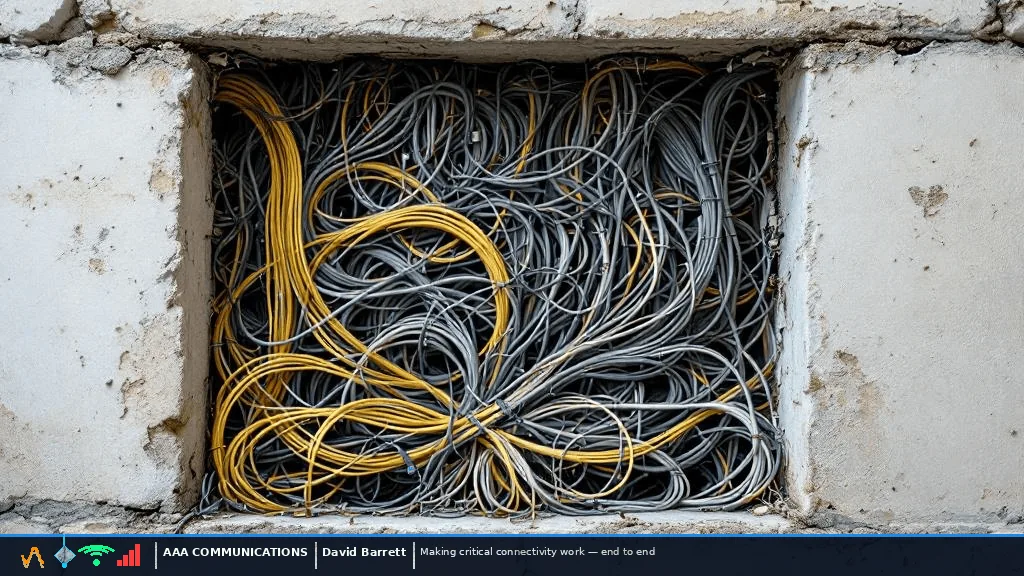
Actual field photograph. Commercial site, Australia, 2025. This is what four decades of undocumented installations looks like when someone finally opens the wall.
Your building retrofit budget assumes the walls contain what the drawings say they contain. When that assumption is wrong, your simple upgrade becomes a full remediation project, with unplanned downtime and a cost blowout that kills the business case before it starts.
What we found
This isn't an edge case. It's the standard.
Last week we opened a wall on a commercial site and found fourteen different cable types from four decades of installations. None of it was documented. All of it was assumed to be fine.
The Cat5e that the facility team believed was supporting their new VoIP system turned out to be Cat3, painted grey and terminated by an electrician who had never worked to TIA-568. The "redundant pathway" to the server room was a single Cat5 cable sharing conduit with 240V mains. A code violation hidden behind plasterboard since 2007.
Most organisations assume their infrastructure matches their documentation. Most documentation was written at installation and never updated. The gap between what the drawings say and what's actually in the wall is where project budgets go to die.
This pattern repeats across every sector we work in: health, retail, industrial, manufacturing. The sites with the most documentation problems are almost always the ones that have changed hands, been refurbished multiple times, or had the most "quick fix" work done over the years. Each trade leaves something behind. Nobody updates the record.
Why it happens
The "get it done and get out" culture that built your infrastructure.
There's a reason this infrastructure ends up undocumented. It's not malice. It's economics and time pressure compounding over decades.
Each project has a budget to protect. The due diligence at the start is thorough, because there's money on the line and nobody wants the project to blow out before it begins. By the time sign-off comes around, the pressure is to close out and move on. What gets inherited is whatever was actually installed, not what was specified.
Project commences with a full scope of works and detailed drawings. Mid-project, a cable run is changed to avoid an obstacle. The drawing isn't updated. A component is substituted because the specified product is on backorder. The documentation reflects the original spec. A pathway is shared with another trade to save time. Nobody notes the deviation. Sign-off happens on schedule. The as-built documentation reflects the design intent, not what was installed.
Five years later, the next project team opens the wall and finds something different from what the drawings show. The original team is long gone. The institutional knowledge walked out with them.
Every subsequent project builds on the undocumented foundation left by the last one. The gap between reality and documentation grows with every trade that passes through. By the time someone finally validates what's actually there, the discrepancy is measured in decades.
"The cost of undocumented Layer 1 infrastructure compounds every quarter you ignore it."
The real cost
It's not the cable. It's what the cable assumption costs you.
The immediate cost is obvious: rework, remediation, delay. A simple upgrade becomes a full investigation. A budgeted two-day job becomes two weeks. The business case that justified the project gets recalculated with numbers nobody planned for.
But the compounding cost is less visible and more significant.
What the thread confirmed
Five industries. One pattern.
The comment thread drew responses from infrastructure professionals across four continents. Every voice said the same thing differently. These are the insights, not the quotes.
From the thread, real voices
83,101 impressions because everyone recognises this.
When this post went up on LinkedIn, it didn't just get views. Field engineers, project managers, facility directors, and infrastructure architects all responded with the same message: we've seen exactly this. The thread confirmed what we see on site every week: undocumented Layer 1 infrastructure is an industry-wide problem, not an isolated case.
Bill, the Gordian knot is the perfect description. And just like the legend, the only solution is to cut through it, except on a live network nobody wants to be the one holding the sword. So it stays. And grows. And the next tenant inherits it.
I have more nightmares about this than I do about failing, or drowning, or being late, or anything else.
Duane, and the nightmare is worse because it's real. At least falling wakes you up. This one follows you into the Monday morning all-hands.
IT'S ALIVE!
Frankenstein's network. The scary part is it was passing ping tests right up until someone actually loaded it.
It's all down to: get it in! Get it done! Send in some fake photos and get paid! It's all down to poor audits and supervisors!
Peter, you're not wrong. The 'get it done and get out' culture is exactly why this infrastructure ends up undocumented. The photo is from a real job site, we see this regularly. The audit trail doesn't lie.
Good point and well constructed. If project exits in terms of snagging validation and sign off were as robust as due diligence and finger printing surveys prior to commencement works you would see a lot less of this.
Padraic, that's exactly where the gap lives. The due diligence at the start is thorough because there's a budget to protect. By the time sign-off comes around the pressure is on to close out and move on. What gets inherited is whatever was actually installed, not what was specified. We see it constantly in brownfield.
I have a confession to make. 30 some-odd years ago, I was doing a lot of video and satellite work on existing live sites. Most of the work was in RG-6, and I don't think I need to tell anyone what a rats nest of black cables in a dimly lit area looks like. I don't even know how many old cables I just abandoned in place, because it was actually cheaper to run new, high quality, properly labelled cable instead.
Documentation is King when you're dealing with any sort of complex system. NOBODY ever complained about having too much information when working on these systems. I literally walk around with sharpies and paint markers in my pockets, and I hand them out to anyone who doesn't have them.
Eric, appreciate the honesty. And you've just described exactly what we find inside walls every week. The abandoned cable isn't laziness. It's a rational decision at the time. The problem is it becomes someone else's mystery a decade later, usually when they're trying to figure out why the new system doesn't work. The sharpies and paint markers in the pocket. That's the right attitude. The people who document as they go are the ones whose work we don't have to reverse-engineer.
Our position
The audit trail doesn't lie. Your documentation might.
We've been opening walls, pulling cables, and validating physical infrastructure since 1992. The pattern hasn't changed. What changes is the load being placed on infrastructure that was never designed to carry it, and the cost when someone finally discovers the gap between the drawing and reality.
Brownfield LAN remediation is one of our core disciplines. We don't assume. We validate what's actually there: with OTDR testing, certification against current standards, full as-built documentation, and a handover pack that reflects reality, not intent.
Full physical audit of existing infrastructure. Cable identification, certification testing, pathway mapping. Remediation scoped against what's actually there. As-built documentation that matches the installation. One accountable partner. Nationwide delivery on live, business-critical networks.
The question isn't whether your facility has undocumented infrastructure. The question is whether you find it on your terms, during a planned assessment, or on the network's terms, during an outage, a compliance audit, or a project that suddenly costs three times what it should.
If the concern is one cabinet rather than the whole site, Cabinet Reset is a smaller, defined package to get that cabinet and its documentation sorted first.
Clearing an old cabinet out? Trace every link and write the do-not-touch list before anything is pulled.
Replacing the cabinet itself and keeping some of the gear? Here is what to keep, what to relabel and what the handover should contain.
Accepting a new install? The 2-minute enclosure check covers the three questions to ask at the open door before you sign off.
Fitting out a boardroom or VC room? The boardroom AV cabling checklist covers the 8 checks to run before the walls close.
When did your organisation last physically validate what's actually inside your walls?
Common questions
When E-Trade was starting up, I remember so many cables were stuffed under the raised floor from prior tenants, it was lifting floor tiles. No one dared to remove any existing cables from that flat gordian knot.