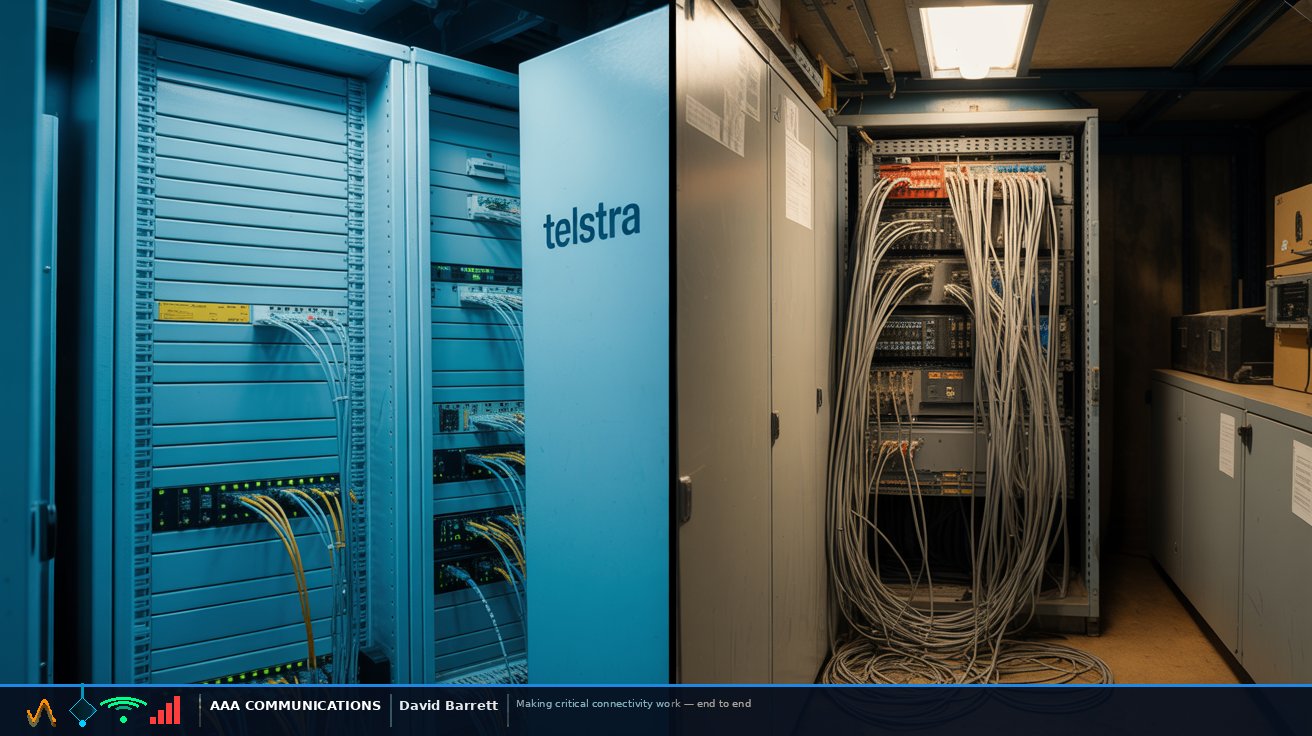
Left: Telstra's handoff point. Clean, validated, carrier's responsibility. Right: your infrastructure. The gap between them is where performance dies.
Most IT directors assume connectivity problems are carrier problems. They're almost never carrier problems. Here's where performance actually dies, and why nobody ever checks.
Left: Telstra's handoff point. Clean, validated, carrier's responsibility. Right: your infrastructure. The gap between them is where performance dies.
Telstra's network responsibility ends at your main distribution frame. Everything beyond that entry point, the horizontal cabling, patch panels, terminations, and connections that actually deliver the signal to your devices, belongs to you.
The gap nobody talks about
When a business logs a Telstra complaint, the assumption is carrier-side. The carrier investigates, finds the handoff point clean, and closes the ticket. The client is still throttled. Nothing changes. This happens constantly, not because anyone is being difficult, but because the problem lives in a part of the network nobody is looking at.
The signal dies somewhere between the building entry and the desktop. That distance is entirely your infrastructure. It was installed years ago, probably never validated, and almost certainly never stress-tested under the load it's now carrying.
That graphic isn't hypothetical. We tested a site last month where Cat5e cabling was choking a 1 Gbps NBN service down to 180 Mbps. The client had been logging Telstra complaints for six months. Telstra wasn't the problem. The cable was.
Businesses are paying for premium NBN speeds they can never actually achieve, because the physical infrastructure between the carrier handoff and the end device was never validated.
Real-world case study
Root cause: legacy Cat5e horizontal cabling incapable of sustaining Gigabit throughput at real-world distances under load. The infrastructure was installed in 2003 and never replaced or certified. The Telstra handoff was clean throughout. Six months of carrier support tickets, closed each time, before the physical layer was ever examined.
Post-remediation: full Gbps performance confirmed via certification testing.
This is not an isolated case. We see it consistently across health, retail, industrial, and manufacturing environments. The symptom is obvious: slow speeds, dropped connections, carrier complaints. The cause takes someone who knows where to look.
"Most teams are watching the speed test, not the retry rate. The symptom is obvious. The cause takes someone who knows where to look."
The technical reality
Incoming bandwidth is only one variable. The path a packet takes from the carrier handoff to an end user passes through a chain of physical and logical components, each one a potential chokepoint. When that chain includes legacy hardware, unvalidated cabling, and mixed-speed infrastructure, contention ratios multiply and individual throughput collapses.
Run a tracert and you'll see where the latency lives. But you still need someone who knows what to do when the answer is "hop 4, your patch panel." Most teams don't. That's half the problem.
From the thread: real voices
When this was posted on LinkedIn, it wasn't just views. IT professionals pushed back, built on it, and validated the same patterns from their own experience. Here are the exchanges that matter.
Phil, you've nailed it. Incoming bandwidth, contention ratios, switching capacity, legacy gear in the path, all of it stacks up before a single packet reaches the end user. Those multi-hop networks with mixed-speed routers are more common than people admit, and they're invisible until someone actually traces the path.
Some residential CPE still ships with 100 Mbps NICs — uplifting Layer 3 will have no effect on download speeds for those devices. Wi-Fi performance is the next challenge for fixed line services — actual performance is well below headline speeds.
Adrian, spot on. Wi-Fi is its own layer of complexity. What we find consistently is that most organisations haven't even got to diagnosing those layers because the structured cabling beneath them has never been validated. Fix the physical foundation first, then work up the stack.
Wi-Fi speeds are limited most often by signal strength. Less strength = more retries.
Correct. Most teams are watching the speed test, not the retry rate. The symptom is obvious. The cause takes someone who knows where to look.
Our position
Every SDWAN upgrade, every Wi-Fi 6 rollout, every 5G in-building project lands on top of physical infrastructure that was installed and never revisited. The headroom that hid the problem disappears. The risk that was latent becomes visible, usually at the worst possible time.
Since 1992, AAA Communications has delivered the Layer 1 infrastructure that enterprise networks depend on. We've been a Telstra Partner for 34 years. We validate and build the physical foundations behind LAN, Wi-Fi, and in-building 4G/5G, where failure is not an option.
From rapid fault isolation to standards-aligned audits, design, installation, and documentation. We make critical connectivity work - end to end. Copper and fibre certification, OTDR testing, RF surveys, heatmaps, spectrum analysis, in-building mobile coverage for all carriers.
We operate on live, business-critical networks. We don't assume. We validate.
The question isn't whether your organisation has a Layer 1 problem. The question is whether you know about it before it surfaces as an outage, a compliance issue, or a six-month run of unexplained Telstra complaints.
Common questions
Carrier delivery and what reaches your team are two different things. Telstra is responsible for the handoff. What happens between that handoff and the device on someone's desk is your internal cabling, and it's rarely tested with the same rigour.
An independent audit of the internal structured cabling, separate from any carrier fault ticket, is the only way to rule it in or out. It's vendor neutral evidence you can bring to either party.
Yes. Most IT directors assume a connectivity issue is a carrier issue by default because the carrier is the visible, billable relationship. The internal physical layer is usually the last thing checked, even though it's often the actual cause.
Yes. Testing and certification are delivered on live networks without downtime, so there's no need to take anything offline to get an answer.
Talk to us about a Layer 1 infrastructure assessment. We work nationwide on live networks, single accountable partner, no assumptions.
Request an Assessment
What was the speed of the incoming connection? You have to consider bandwidth and the number of users to determine individual connection speeds. Switches and hubs also play a major part. Legacy networks where connections pass through multiple routers with differing speeds effectively reduce individual throughput.