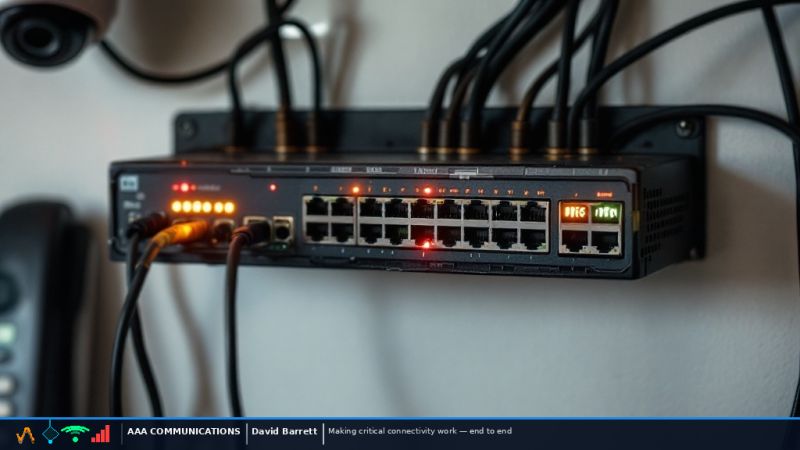
An access switch sized for IP phones, now sharing its PoE budget with cameras and access points. The load climbed. The budget did not.
The test proved your infrastructure met design spec at commissioning. That spec did not include Teams, Wi-Fi 6 access points, cloud ERP, and a floor of PoE cameras. The acceptance test is not evidence the network carries today's load. It is evidence it could carry 2017's.
An access switch sized for IP phones, now sharing its PoE budget with cameras and access points. The load climbed. The budget did not.
A successful site acceptance test is a snapshot in time. It is not a lifetime guarantee of performance. The day it was signed off, your network met the spec. Every device added since has been quietly spending headroom that test never measured.
What the test actually proved
That 2017 test proved your infrastructure met the design spec at commissioning. Nothing more. The design spec was written for the world as it was when the cable went in.
It did not include Microsoft Teams running all day on every desk. It did not include Wi-Fi 6 access points, cloud ERP, digital signage, or a floor of PoE cameras that nobody had quoted yet. The spec was honest about the load in front of it. It could not account for the load that arrived later, one device at a time, with no revalidation in between.
A pass certificate gets filed and treated as permanent. It is not. It certifies a moment. The longer that moment sits behind you, the wider the gap between what the test proved and what the network is now being asked to do.
How the load changed
The architecture matters here. Networks designed before 2020 were built around east-west flows, traffic moving between local servers inside the building. The cabling, the switching, the uplinks, all of it was sized for that pattern.
What you are pushing now is the opposite. Persistent, latency-sensitive, north-south traffic to the cloud. SaaS platforms, hosted voice, cloud ERP, video that never stops. The architecture was never intended to carry it, and certainly not at this volume. The pipes still light up green. The pattern running through them changed completely.
"The acceptance test signed off on a load. It never signed off on the one you are running today."
Where it breaks first
Watch the access layer. Switches installed in 2016 were sized for IP phones and basic access points. That was the brief. Then someone added Wi-Fi 6 access points, digital signage, and a camera array, and now the switch is drawing against a power budget it can no longer meet.
Here is the part that hurts. It will never alert you about it. The switch throttles devices to stay inside its budget. The sensors keep blinking. The switch keeps switching. Nobody knows anything is wrong until the Monday morning Teams call drops and the problem gets blamed on the application, the laptop, or the internet, anything except the physical layer that quietly ran out of room.
What the thread confirmed
When this went up on LinkedIn it did not just draw views. It drew network engineers, architects, and infrastructure leaders, including people inside major carriers and vendors. Twenty thousand impressions, forty-one comments, almost no ad reach. Every voice described the same pattern from a different angle. These are the insights, not the quotes.
From the thread · real voices
The strongest replies were not agreement. They were engineers adding the part the post left out, and a few pushing back hard enough to sharpen it. Here is the exchange that mattered.
Peter, oversubscribed uplinks is the one most people miss entirely. Everyone audits the access layer eventually. Almost nobody goes back and recalculates the uplink the access layer depends on after five years of device growth. Same blind spot as the PoE budget, just one layer up.
This highlights a classic problem where network engineering is its own worst enemy. The components are tied to performance specs that newer tech eventually usurps. In many cases the business refresh budget cycles are not aligned with technical lifecycles, especially at Layer 1. An upgraded optical plant becomes a very hard sell.
Seen many networks have a full refresh, then you find mixed L2 priority clashing with DSCP, TOS and MPLS shaping, mixed frame and packet limits, unlicensed radios using TDD with pseudo full duplex ruining latency for sync and voice, and the odd unmanaged 1Gbps switch on a 2014 chipset.
Spot on, Stephen. SDN and YANG will tidy a lot of that mess in the control plane, but they are still describing a topology, not validating it. The unmanaged 1Gbps switch on a 2014 chipset will not show up in any YANG model until someone has physically traced the cable and found it. That is the gap.
It all depends on the advice of the data cabling company that gave you that future proof solution, and the initial conversation about what you need the network to do, with knowledge of what is just around the corner. We are the experts, not the client.
Graham, agreed on the expert accountability point. Where I would push back slightly is on future proof. Nobody specs for a load that does not exist yet, and growth always outruns the original brief, more access points, more cameras, more devices than the original bill of quantities ever accounted for.
If you have a site that pulls from servers, your endpoints have the same requirements they always did, unless your software changed. If it moved from desktop apps to SaaS, your network requirements tend to go up. Wi-Fi 7 might need new infrastructure, but only if you actually need that bandwidth.
Paul, agree where it is a deliberate move. A SaaS migration or a planned Wi-Fi upgrade comes with its own budget and revalidation. The cases I am pointing at are different. Nobody decided to add 40 more PoE cameras and a couple of repeaters over five years. It happened in increments, and the 2017 acceptance test never got revisited.
Our position
We have been validating physical infrastructure under real-world demand since 1992. The acceptance test is not the problem. Treating it as permanent is. The load keeps climbing after sign-off, in increments small enough that no single one triggers a review, until the headroom is gone and something drops.
A Layer 1 network audit measures the network against the load it carries now, not the one it was commissioned for. PoE budget assessment, uplink and thermal review, certification against current standards, and as-built documentation that reflects what is actually installed. Where the answer is cellular resilience rather than more copper, our in-building 4G and 5G coverage work covers it.
Physical audit of the installed infrastructure. PoE budget and uplink load assessment against current device count. Thermal review of the IDF and comms room. Certification to current standards. As-built documentation that matches reality. One accountable partner, nationwide, on live business-critical networks.
The acceptance test answered one question, on one day, about one load. The only question that matters now is whether the network still carries what you are actually putting through it. You find that out on your terms, in a planned audit, or on the network's terms, during the outage.
Testing proves it works. Before you sign off, the 2-minute enclosure check asks whether it's finished: three yes or no questions at the open door.
Common questions
Find out whether your network still carries what you are putting through it, on your terms, in a planned Layer 1 audit.
Book a Layer 1 Audit
Thank you for this insightful perspective. It is a timely reminder that a successful site acceptance test is a snapshot in time, not a lifetime guarantee of performance.