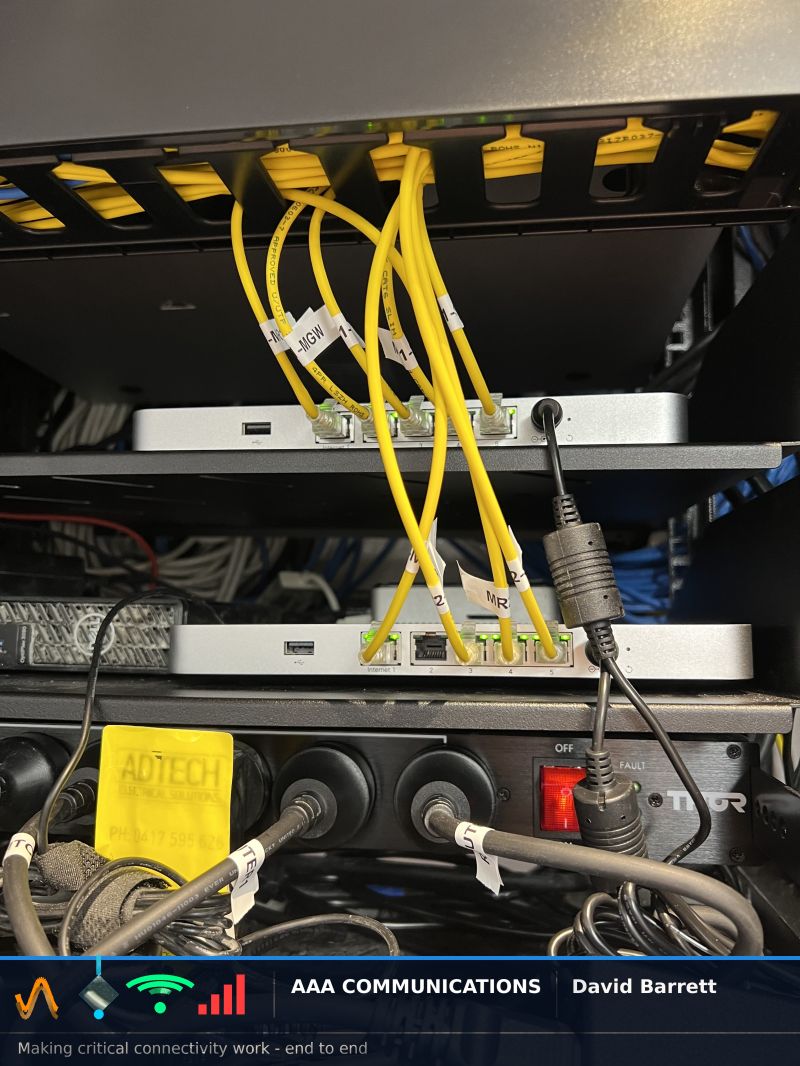
Actual field photograph. The dual-gateway rack from the original LinkedIn post, MGW and MR uplinks patched and labelled, TIVR UPS beneath.
Actual field photograph. The dual-gateway rack from the original LinkedIn post, MGW and MR uplinks patched and labelled, TIVR UPS beneath.
No, it hasn't. Unless someone has deliberately pulled the primary link under real production load and watched the backup take over cleanly, the failover has never been tested, only assumed. Dual-gateway SD-WAN, VRRP handoff, GRE tunnels between Meraki devices, none of that architecture proves anything about the physical channel it depends on. And that channel is almost never validated once the rack is live.
Control plane vs. physical layer
A failover demo proves the control plane works. It doesn't prove the cable does. Two gateways sharing WAN uplinks with a virtual IP handing control to the backup the instant the primary drops is genuinely solid engineering. None of it matters if the copper underneath is already compromised.
The Cat6 spec gap
Cat6 is rated for 250MHz, but that spec applies to the cable on its own, not the jack, the patch panel, the cross-connect and every termination in between meeting the same standard. Cabinets get opened where every patch cord looks new and every termination behind it is rough, or undertwisted, or barely passing a visual check. On a dual-uplink setup, a degraded channel on one path doesn't show up as an outage. It shows up as a fault that only appears under load, at 2am, exactly when the failover is supposed to quietly do its job.
Failure signature
The failure mode that catches people out isn't dead, it's intermittent. A hard failure gets fixed fast because it's obvious. A degraded channel that drops packets only under load can sit there looking healthy on every dashboard for months.
Months of an invisible failure add up to real money once you put a number on it: our free outage cost calculator builds an estimate from your own assumptions about downtime and lost trade.
Under pressure
When a carrier link drops and someone is tracing which cord terminates which uplink under pressure, a mislabelled port turns a five-minute fix into an hour of guesswork. Redundancy at the gateway level assumes integrity at the physical layer underneath it. Most SD-WAN deployments never test that assumption until the day both links are needed at once. Keep Trading Connectivity is built to test it deliberately, with a live failover test on the connections the business actually depends on, before the untested day arrives on its own.
What the field confirms
Who we are
AAA Communications has operated as a Telstra Partner since 1992, delivering Layer 1 infrastructure validation, structured cabling, and in-building 4G/5G, Wi-Fi and SD-WAN validation for enterprise, industrial and critical environments across Australia. We test the physical layer under real-world load before it becomes the reason a redundant system fails, because redundancy at the network layer is only as good as the channel it depends on.
Common questions