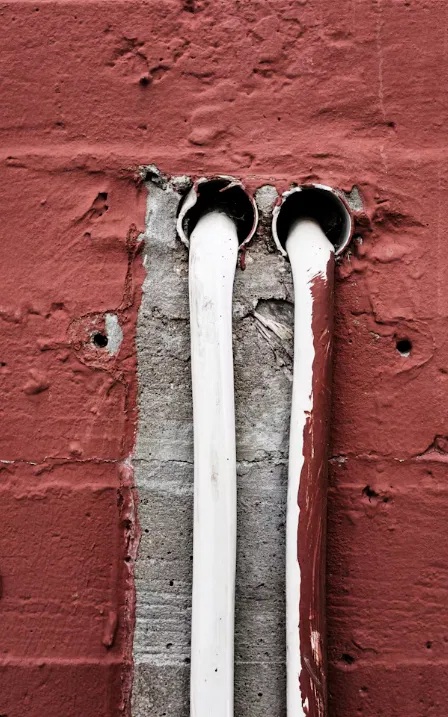
Two conduits, one entry point. If both of your "diverse" services come in this way, one event at the wall takes out both. Illustrative photo, not the incident site.
One cut fibre cable grounded five major US airports for eight hours. The backup existed on paper. Two exchanges, two routes, two entry points: if your carrier can't name all three, you're buying two circuits, not diversity.
Two conduits, one entry point. If both of your "diverse" services come in this way, one event at the wall takes out both. Illustrative photo, not the incident site.
Redundancy is something you buy. Diversity is something you prove. Plenty of organisations pay for the first and assume the second, and only find out otherwise when one cable goes and the other turns out to be no help at all.
What happened
On Sunday 20 September 2026, the US Federal Aviation Administration moved its Philadelphia air traffic control facility onto its backup telecommunications line after error messages appeared on the primary circuit. Then a construction crew working on a rail project in New Jersey cut a Verizon fibre cable. It was carrying the backup.
With the primary already out of service, there was nothing left. Ground stops hit five airports: Newark, Philadelphia, JFK, LaGuardia and Teterboro. Thousands of flights were delayed or cancelled, and the repair took around eight hours. The crew reported they were digging roughly 10 feet from the utility markings.
Two paths existed. But once the primary was down, every flight in that airspace depended on a single cable running beside a rail line where construction work was under way.
"Two communications links means that if anything happens to one of them, you're operating on zero redundancy."
The legal view
Telecom law firm CommLawGroup reviewed the incident and landed somewhere most network teams never look: the agreement. Cable strikes are not rare events either. The Common Ground Alliance, a US damage prevention body, puts the cost of buried utility damage at about US$83 billion a year.
Make sure primary and backup facilities don't share vulnerabilities such as location, conduit systems or construction zones. Define responsibility for notice, facility marking, contractor oversight, insurance and damage liability before work begins.
Put simply, physical diversity shouldn't be something your network team assumes. It should be something a contract makes someone prove.
Where it gets lost
When we discussed the incident on LinkedIn, the most telling stories weren't about cables. They were about budgets.
A developer with nearly 40 years in the industry recalled IT requisitioning two T1 lines for redundancy. By the time the order reached purchasing, it had become a single T3, because it delivered the same bandwidth for less.
Same bandwidth. Same SLA on paper. Zero resilience left. The requirement survived engineering and died on a spreadsheet that didn't know what it was cutting.
An outside plant veteran in the same discussion described the other half of the problem. Challenge a design on whether it's truly redundant and the pushback is usually commercial, not technical. Once "fully redundant" has been written into a scope of work, admitting the paths aren't diverse means reopening a conversation nobody wants to have. So the diagram stays as it is.
Before you sign
Before you sign for a redundant or "diverse" link, get three things from the carrier in writing: the two exchanges serving your primary and backup, the route each path takes to your building, and where each one enters the building. If they can't provide all three, you're buying two circuits, not diversity.
A requirement that isn't written into the agreement is only a preference. Get the three answers into the order or contract so someone is accountable for them.
The honest limit
Some buildings have a single incoming lead-in, and no amount of paperwork changes that. Physical separation at the front door isn't always possible, particularly in existing and multi-tenant sites.
That doesn't make diversity pointless. Serving your primary and backup from two distinct exchanges still removes the largest shared risks out in the network. What matters is that the remaining shared section is known, documented and accepted as a risk, rather than discovered during an outage.
Then the question changes from "what should we buy?" to "what did we actually get?" That's a physical verification job, covered in Route diversity: when both paths share the same trench.
What the thread confirmed
The original post drew 5,142 impressions and a discussion that went further than the post did. Telecommunications made up 42% of the audience. These are the insights, not the quotes.
Above Layer 1
The documentation specialist in the thread made a point worth repeating: physical diversity reduces physical risk, but the logical design has to match it, at the network, system and authentication levels. Static routes and manual failover don't help if the paths still converge somewhere else.
Two diverse fibres landing on one device is still a single point of failure. Test failover the way it will actually happen, not the way the diagram suggests. We cover that in Your redundant network has never actually failed over.
After you sign
In October 2026, St. Mary's County in Maryland asked carriers to quote a second, separate internet line for its backup emergency site. A cut on the state fibre network's route through Hollywood had severed roughly 500 strands, and the county's new CIO described the goal as "no shared fate": two lines, two physical paths, so one cut can't take out both.
When we posted about it, the people who plan, build and run these routes added what the checklist above doesn't cover: where two links usually meet, what happens after handover, and who pays to keep them apart. In the buildings we work in, a single incoming lead-in is often unavoidable, so the shared points are worth knowing before you sign, not after.
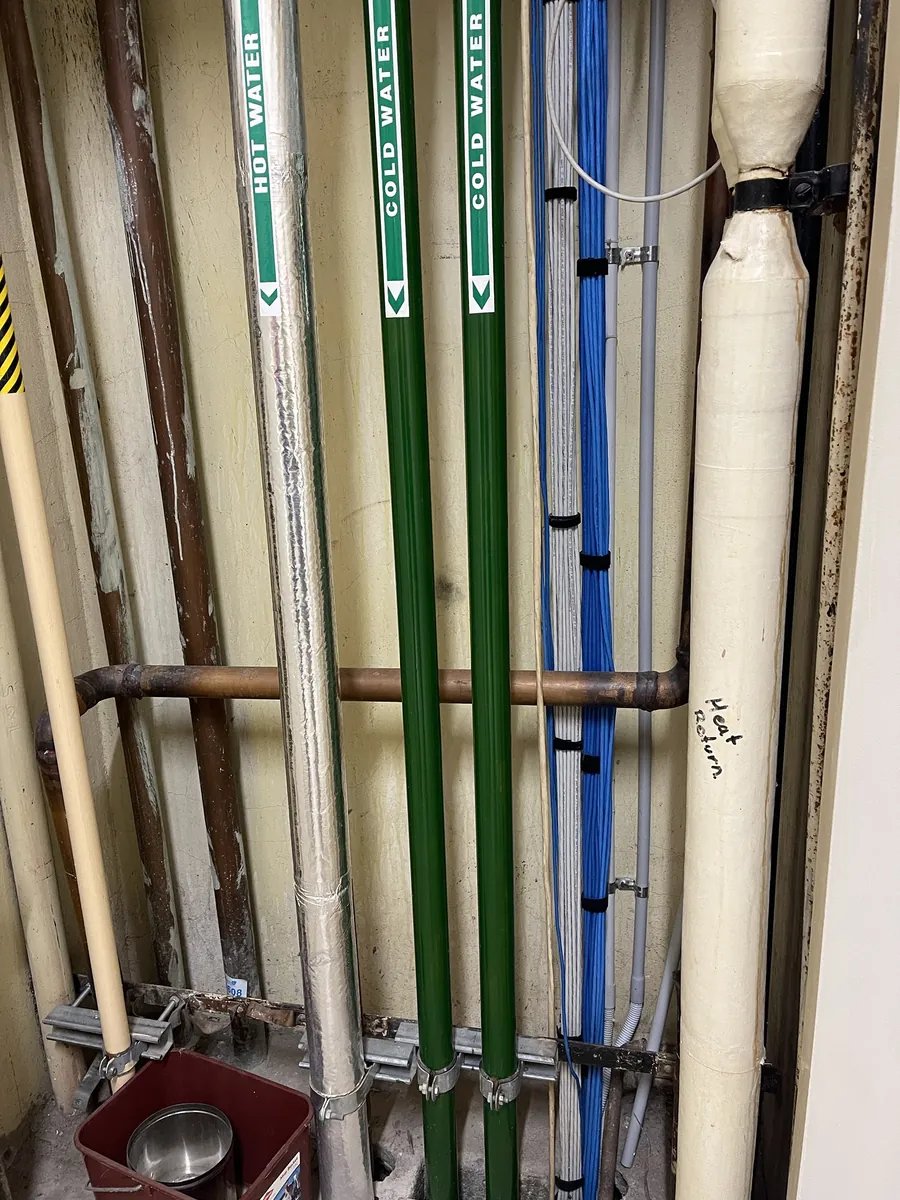
Two services can be separate at the exchange and still share one point on the way in. These are the usual places, and who can tell you about each one.
| Shared point | Usually owned by | Who can confirm it |
|---|---|---|
| Exchange | Carrier | Each carrier, in writing |
| Point of presence (POP) | Carrier | Each carrier, in writing |
| Street duct and conduit | Carrier or network owner | Each carrier, in writing |
| Pit or chamber | Carrier, or the property owner on private land | Carrier, plus a site check where the pit is on your property |
| Building lead-in | Building owner (entry), carrier (cable) | A site check of where each service enters |
| Riser and pathways | Building owner | A site check of the riser and pathways |
| Comms room or MDF | Building owner or tenant | A site check of where each service terminates |
We can check the points on your site. Anything on the carrier's side of the boundary has to come from the carrier, in writing.
"The ideal solution would be to route diverse external cables to opposite ends of the building. These would each terminate in separate meet-me rooms and have diverse routes to the data hall. No SPOF! This is doable if the will is there and the user understands the implications of what they currently have."
On who pays: "It would have to be the owner of the building as they would need to agree any new openings and internal routes, which would probably require punching through walls and ceilings."
"I planned quite a number of these; most were completely diverse; they entered the chamber at opposite ends, whenever possible, and thankfully, only a few had to enter via the same duct or at least, the same side of the chamber."
"It seems that a wireless connection would have been a better redundancy option, reducing possible single points of failure. It could be a 3rd option to the above."
On the riser photo: "There are a lot of heat sources in that photo."
1. Route changes. Ask each carrier, in writing, whether they will notify you if your service is moved to another path. Expect resistance, and recheck the route on a set schedule either way.
2. The second entry. Ask who owns and pays for a second building entry before you assume one exists. New openings usually need the building owner's agreement.
3. A third path. Ask whether a service on a different medium, such as wireless, should sit alongside the two fixed links, and where its backhaul runs.
Our position
Diversity requests are handled on request, and we rely on each carrier to advise the route details. On your site, we check what both services share where we can see it: the lead-ins, pits and risers.
Both exchanges named by each carrier, in writing. Both routes and both building entry points named. Anything the two services share on your site, checked before the circuit goes live. One accountable partner, nationwide, on live business networks since 1992.
Diversity you can't produce on paper is diversity you're hoping for. The time to find out is before you sign, not when the excavator does.
Route details beyond your site come from each carrier. We help you ask for them, and we check what we can see.
Common questions
Sources
CommLawGroup: When a fiber cut grounds airports
Cabling Installation & Maintenance: Fiber cut causes air traffic control outage
US News / Reuters: FAA says error messages prompted shift to backup
ABC News: US flights disrupted as cable is cut
Southern Maryland Chronicle: St. Mary's seeks backup internet route after fiber cut
A$290 ex GST site assessment, on site within 48 hours in Sydney: up to 90 minutes on site, report within 48 hours of the visit. Send us the site address and the services you're ordering. The A$290 is credited in full if you go ahead with the quoted work.
Book the A$290 site assessmentNot ready yet? Send 3 photos. Get a free cabinet review.
"Everything checks as diverse at time of handover, then vendor B has maintenance or an issue and reroutes your path to their internal path backup route and you are now unknowingly in the same conduit/pop with vendor A. No notice, no indication. And normally you stay there until they have a reason to switch you back."
On getting change notification into a contract: "Anything in the contract that is not part of their general ingrained process is near impossible to get them to implement reliably."