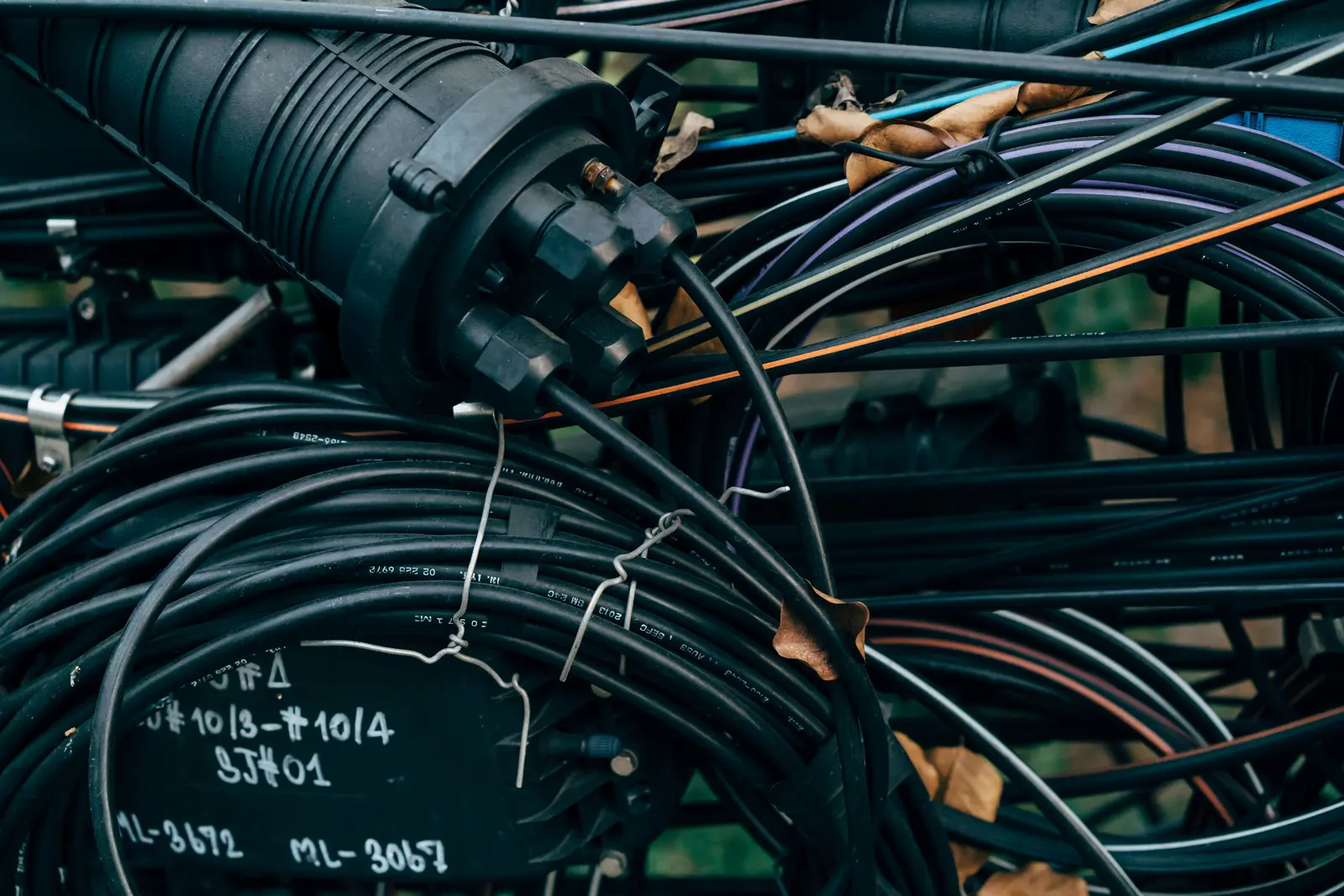
The conduit on the kerb. Every diverse route on a network diagram passes through somewhere like this.
Someone walked up to a fibre run in Santa Clarita and cut it. Deliberately. Crews spliced more than 700 fibres by hand to bring service back, and 911 dispatch was degraded while they worked. The internet is still a physical thing. Glass. Conduit. A pit with a lid on it. And a pair of bolt cutters is enough.
The conduit on the kerb. Every diverse route on a network diagram passes through somewhere like this.
Every one of those 700 strands was somebody's payment terminal. Somebody's clinic. Somebody's 911 call. A route diversity failure that most enterprise networks are quietly carrying right now, and a reminder of what the network actually is when you stop looking at the diagram.
What happened
On 7 July 2026, fibre optic lines in Santa Clarita, California were intentionally cut in what Spectrum publicly confirmed was a criminal attack on its critical infrastructure. Not an excavator strike. Not a routing or config issue. A deliberate act, and a pair of bolt cutters was enough.
While crews spliced more than 700 fibres by hand to restore service the same day, the local sheriff's station phone lines were degraded and emergency dispatch was rerouted to a station roughly 26 miles away. That was not a hypothetical stake. It happened, on a Tuesday, in a first-world network. And 911 dispatch was degraded while crews were splicing.
Spectrum reported the telecommunications industry experienced 18,327 attacks on communications infrastructure in 2025, a 59 percent increase on the year before, affecting more than 11.8 million customers. Deliberate physical attacks on the network are not an edge case. They are a trend line.
Splicing 700 fibres is heroic work. Nobody wants to be the customer relying on it finishing before their SLA clock runs out. Which raises the question every IT executive should have asked by the end of that day: would our redundancy have saved us?
The costume
The design says two carriers, two handoffs, diverse routes. The invoice says it twice. Then you trace the physical paths and both "diverse" circuits converge in the same trench for the last two hundred metres into the building. Same duct bank. Same pit. Sometimes the same cable sheath.
That is not diversity. That is a single point of failure wearing a costume. Carrier diversity is a contract. Route diversity is geography. The two get used interchangeably in procurement documents, and the difference only surfaces on the day something physical fails, which is exactly the day it is too late to discover it.
The field put it more precisely than any standard does. Redundancy means you have a second path. Diversity means the second path cannot fail for the same reason as the first. Most networks have the first. Very few have verified the second.
There is no such thing as resilient diversity in networking. There is redundancy. Genuinely independent paths, end to end, only buy you odds, not certainty. But odds are the whole game.
What the field said
The thread drew field engineers and architects from AT&T, Cisco, Verizon, Lumen, Comcast, Nokia and Telstra. Forty-six percent of viewers came from telecommunications, a third at senior level and above. These are the people who splice the fibre and design the routes, and they confirmed the pattern from the inside.
That's the clearest breakdown of collapsed rings I've seen in this thread, Kyler. Same sheath, different fibres, logical redundancy sitting on a physical single point. Most people never get past "it's a ring so it's redundant" without asking what's actually inside it. Glad the fire got you funding before something worse did. 128 fibres under pressure is still a hell of a day's work.
Diversity in outside plant is not sufficient if it doesn't exist inside also, all the way to the equipment in the rack. Too often, "diversity" is used when "redundancy" is correct. They are not the same thing.
Right down to the rack is exactly where it usually falls apart, Eric. Outside plant gets the diagram and the budget, inside plant gets ignored until two "diverse" circuits land on the same switch. And you're right on the terminology. I've been loose with "diversity" when redundancy is the more accurate word for what people actually mean.
Enterprises can order all the redundant paths from one service provider and gain assurances and proof. But carriers cannot share fiber cable route details with other carriers, and it can be difficult for enterprises to obtain the KMZ files with enough detail from all involved carriers to try ensuring diversity themselves.
Good point, Daniel. Service managers help, but they're still relying on what each carrier discloses about their own network. The KMZ gap is the real problem. You can get assurances from three providers and still have no way to independently verify the routes don't converge somewhere in the last few hundred metres. That verification has to happen on site, not on paper.
Years ago on a project for a large financial company, each site had two circuits — "diverse." Each circuit went to the same LEC router. Some were Cienas, some Canoga Perkins. Verizon was last mile. After the first hop it was ATT on the 2nd. Diverse in thought, not in delivery.
Cienas and Canoga Perkins converging on the same LEC router. That's the tell every time. Doesn't matter what colour the diagram is if both circuits hand off to one router before they even leave the building. "Diverse in thought, not in delivery" sums up half the audits I've seen too.
In Asia, when we connected factories to the Telco POP, in the dead of night we would bury the real cable about 10 feet deep and the next day, in plain view of everyone passing by, we would bury a sacrifice cable designed to be stolen without disrupting business operations. Worked pretty good.
That's brilliant, Art. Real cable buried out of sight, decoy cable in plain view designed to be stolen without touching operations. That's proper security thinking: work with the threat instead of pretending it doesn't exist. Wish more businesses budgeted for a sacrifice layer instead of hoping nobody notices the real one.
Our position
We have been validating physical infrastructure on live networks since 1992. Layer 1 is where the business actually lives or dies, and it is the layer that procurement paperwork describes but never proves. We have walked into sites where the "redundant" path was in the same trench as the primary. Backup power is the same story: exists on paper, never proven under load.
Route diversity cannot be confirmed from a desk. Carrier maps stop at the boundary of each carrier's own network, KMZ files rarely carry enough resolution, and the convergence point is almost always in the last few hundred metres: the shared duct bank, the common pit, the single lead-in. The only reliable method is the same one that underpins every Layer 1 network audit we deliver: trace the physical paths as they actually exist, port by port and run by run. The same discipline drives our brownfield LAN remediation work, where the audit comes first, not last.
Physical trace of both circuit paths from carrier handoff to rack. Identification of shared trenches, duct banks, pits, lead-ins, risers and termination points. Confirmation of separation inside the building, not just outside it. Verified as-built documentation of what is genuinely independent and what only looks that way. One accountable partner, nationwide, on live business-critical networks.
Making critical connectivity work - end to end, starts with knowing where your glass actually goes. Redundancy on paper does not protect a service loop hanging off a bridge, a collapsed ring inside one sheath, or two circuits handing off to the same router in the basement. Verification does.
Common questions
Carrier diversity means your circuits are delivered by different providers. Route diversity means the physical paths never share the same trench, duct bank, pit, cable sheath or point of presence. You can have two carriers and zero route diversity: if both circuits ride the same duct bank into your building, one pair of bolt cutters takes out both. Carrier diversity is a contract. Route diversity is geography, and only a physical trace proves it.
No. Redundancy means you have a second path. Diversity means the second path cannot fail for the same reason as the first. Two circuits that converge in the same trench for the last two hundred metres are redundant on paper and a single point of failure in the ground. Diversity is the stronger claim, and it has to be physically verified rather than assumed from a diagram.
A collapsed ring is a design where the logical ring does not run on physically separate routes. Individual fibres within the same cable sheath are spliced together to logically route back to a hub. On a diagram it looks like a redundant ring. In the ground it is one sheath, one physical point, and one cut or one fire away from losing the entire ring at once.
By physically tracing both paths, not by reading the as-builts. Verification confirms the two circuits enter the building through separate lead-ins, ride separate risers, terminate on separate equipment, and never converge in the same trench, duct bank, pit or point of presence in the last few hundred metres. That work happens on site, not on paper.
Each carrier only discloses its own routes, usually under NDA and often at low geographic resolution. When your two circuits come from two providers, no single map shows where their physical paths converge. The convergence point is almost always in the last few hundred metres, and that gap can only be closed by physical inspection.
On 7 July 2026, fibre optic lines in Santa Clarita were deliberately cut in what Spectrum confirmed was a criminal attack on its critical infrastructure. Crews spliced more than 700 fibres by hand to restore service the same day, while sheriff's dispatch was rerouted roughly 26 miles away. Spectrum reported 18,327 attacks on US communications infrastructure in 2025, a 59 percent increase year on year.
Before the excavator, the fire or the bolt cutters find it for you. A Layer 1 audit traces both paths and tells you what is genuinely independent and what only looks that way.
Book a Layer 1 Audit
I've seen outside fiber plants use collapsed rings, which is redundant when transmit equipment goes down, but not when a locator misses the cable. I spliced 128 fibers that day. I later led the installation of a truly redundant fiber ring in a manufacturing plant where a fire exposed the weakness — the ring doesn't run on separate physical routes, it uses different individual fibers within the same cable sheath spliced together to logically route back to a hub. Redundancy on paper is not always redundant in practice.