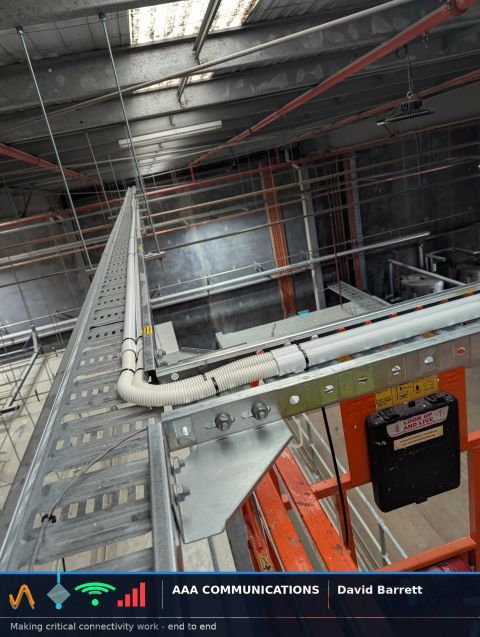
Photo from the original LinkedIn thread. Warehouse cable tray at height, fibre backbone with a flex transition around a structural obstruction.
AAA Communications has designed, installed and audited Layer 1 infrastructure in industrial and warehouse environments across Australia since 1992.
Photo from the original LinkedIn thread. Warehouse cable tray at height, fibre backbone with a flex transition around a structural obstruction.
Warehouse automation is being deployed faster than the cabling infrastructure underneath it was designed to support. AMR fleets, sortation systems and real-time inventory feeds all depend on a fibre backbone that usually runs through roof space, installed in one pass before racking went in and access became difficult. The constraint on that infrastructure is rarely the install cost. It is the cost of touching it again once the building is full, which is a licensed operator in an elevated work platform rather than a technician on a ladder.
A fibre run looks fine from the warehouse floor. It looks fine right up until someone has to touch it again. Getting a licensed operator back up in an EWP basket to fix it in twelve months is a different budget line entirely, and it is almost never the line that got scrutinised when the job was quoted.
The bend in that cable tray was someone's decision. Either it was engineered for growth, or it was the minimum needed to get the job signed off. From the floor, twenty metres down, those two decisions look identical.
Warehouses are being built for automation faster than the cabling standards are catching up. Every AMR, sortation system and real-time inventory feed depends on the fibre backbone running through that roof space. Most of it goes in at once, under time pressure, before racking makes access difficult.
That sequencing is the whole problem. The cabling goes in during the window when access is easiest and the future load is least understood. By the time anyone knows what the building actually needs to carry, the racking is up and the tray is twenty metres above a working floor.
Ceiling spaces where three different contractors had run cable through the same tray over a decade, none of them documenting fill ratios or bend radius, each assuming the last person knew what they were doing. Nobody did.
"The one that sticks with me is a site where the tray had three different contractors' work in it, and none of them had labelled a single run. The fault find alone took longer than the actual fix once the EWP was up there."David Barrett, own comment on the thread
That is the real shape of the cost. Not the repair. The forensic exercise before the repair.
William Finnick, Senior Network Engineer at Americold, made the point directly in the thread: maintenance is the last criterion of design, but it is a criterion, and it needs attention if you ever have to go back to repair or troubleshoot.
"No records of fill ratio, bend radius and pull points means every repair starts with a forensic exercise before you've even fixed anything. Maintenance access isn't nice to have, it's the difference between a quick fix and a half-day investigation."David Barrett, reply to William Finnick
Mike Parker raised a genuine technical challenge on the photo itself: using flex for the ninety-degree turns means you are actually turning more than ninety degrees, closer to a hundred and twelve in practice, and depending on fill and cable type that raises a real question about whether it meets the requirements for communication cabling.
He is right, and the distinction matters. On this particular site the flex was a transition piece to get around an existing structural obstruction, with the backbone itself running in proper tray and correct bend radius maintained. But flex does get misused as a lazy fix on plenty of sites, and cumulative bend beyond ninety degrees adds friction and risk, to fibre in particular.
That is the kind of detail that never shows up in a handover document, and never gets questioned from floor level.
Pawel Kuna asked a fair question of the same photo: why separate fibre from power on a tray twenty metres up?
The answer is sequencing again. That was new tray for edge cabinets, installed before the copper went in. Separation requirements kick in the moment that containment is shared, not the moment someone notices it is being shared. Designing for the containment's eventual contents rather than its current contents is the difference between a compliant install and a remediation job.
From the thread
Undersized containment, poor separation from power, no allowance for future pulls. None of that shows up until someone needs to add capacity and discovers the access itself has become the obstacle.
A cable tray that was cheap to install once and expensive to touch again is not a saving. It is a deferred cost with a licensed operator attached to it.
The question worth asking before the racking goes up is not whether the cabling meets the standard today. It is whether anyone will be able to work on it in three years without an EWP, a licence and a shutdown window. That is a design decision, and it gets made once, early, usually by whoever is trying to get the job signed off.
AAA Communications designs, installs and audits Layer 1 infrastructure for industrial and warehouse sites, see our Industrial & Manufacturing Cabling service.
Adding hardware without checking what's already there isn't unique to warehouses. See 12 access points in 18 months.
Common questions