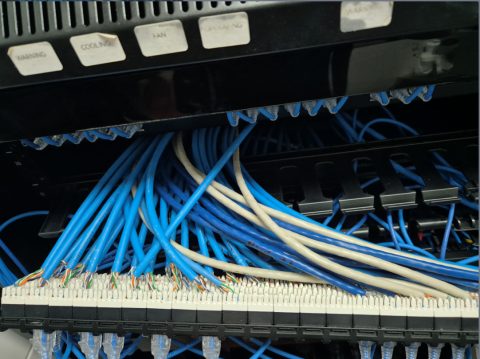
Because the cables had nothing holding them in place except their own terminations. With no strain relief bar fitted, pulling the panel forward to reach one bad port put tension on every cable in the bundle. Fix one, drop three.
A technician fixed one failed port on this panel. The fix worked. Three other services went down with it.
No strain relief bar was ever fitted. Every cable in that bundle is held in place by nothing but the friction of its own termination. Pick up the panel to reach one bad port and you're putting tension through all of them.
It gets worse. This cabinet sits on castor wheels, and it was never locked down after install. Someone leans on it, someone rolls a trolley past it, someone moves it six inches to get behind it, and cable strands start walking out of ports on their own. No technician required. No fault ticket that makes sense until someone traces it back to a cabinet that shouldn't still be mobile.
Nobody signed off on this as a risk. It just never got fixed after fit-out, and every job since has been building on top of it.
It gives the bundle something to hang from other than its terminations.
Cables are dressed and tied to a bar behind the panel, so the weight and movement of the bundle sit on the bar, not on the pairs punched into the back of the panel. Without it, every cable is load-bearing at the one point it was never designed to carry load. The same principle applies to patch leads in the last three metres, where most of the day-to-day movement happens.
Because every movement of the cabinet becomes movement at every termination.
Castors are there to get a cabinet into position. Once it's there, it should be locked or fixed. A cabinet left mobile after handover turns ordinary activity in the room into a slow, invisible fault generator. The faults look random because the cause isn't on anyone's fault list.
Because Cat6A is less forgiving of movement at the port.
Cat5 and Cat6 have enough give to forgive a bit of movement at the port. Cat6A doesn't. The same rolling cabinet that was a slow leak with older cable becomes an active fault generator once a site's been upgraded. Nobody re-assesses the mechanical risk just because the copper spec changed.
There's a fair counterpoint:
Keystones help. They don't remove the load. The panel in this cabinet is a punch-down panel, and keystone or not, pulling an unsupported panel forward still puts the tension of the whole bundle onto its terminations.
Because they're cheap to prevent on install day and expensive to diagnose afterwards, and nobody owns them in between.
Richard has 33 years in fibre and data, and his split is the right one. Strain relief skipped is a technician cutting a step under time pressure. Castors never locked down is nobody owning sign-off before the cabinet got waved through at handover. Same invoice, same site, two completely different failures to fix. The second is the more expensive miss long term, because nobody's chasing it until it lands on someone else's fault ticket months later.
When Max Migliore asked who does work like this, the honest answer was: whoever did the original fit-out, and every contractor since who worked around it instead of raising it. Nobody signs up to fix what they didn't break. That's the same question of who owns the risk in that cabinet.
Six things, checked at the back of the cabinet, not the front. These are the mechanical checks a structured cabling audit should cover alongside certification results.
Richard Seccombe added this one after the article went live: a rear-of-cabinet photo at handover costs nothing on the day and gives whoever inherits the site something real to compare against, since most of these faults are hard to trace because nobody knows what "right" looked like at fit-out.
AAA Communications, a Sydney-based Layer 1 infrastructure specialist and Telstra Partner since 1992, checks strain relief, cabinet security and cable support as part of every cabling audit and remediation, on live sites nationally.
Common questions
Send us 3 photos of the back of your cabinet. A technician tells you whether the bundle is supported and the cabinet is secure. Free, same day.
Get a free cabinet check