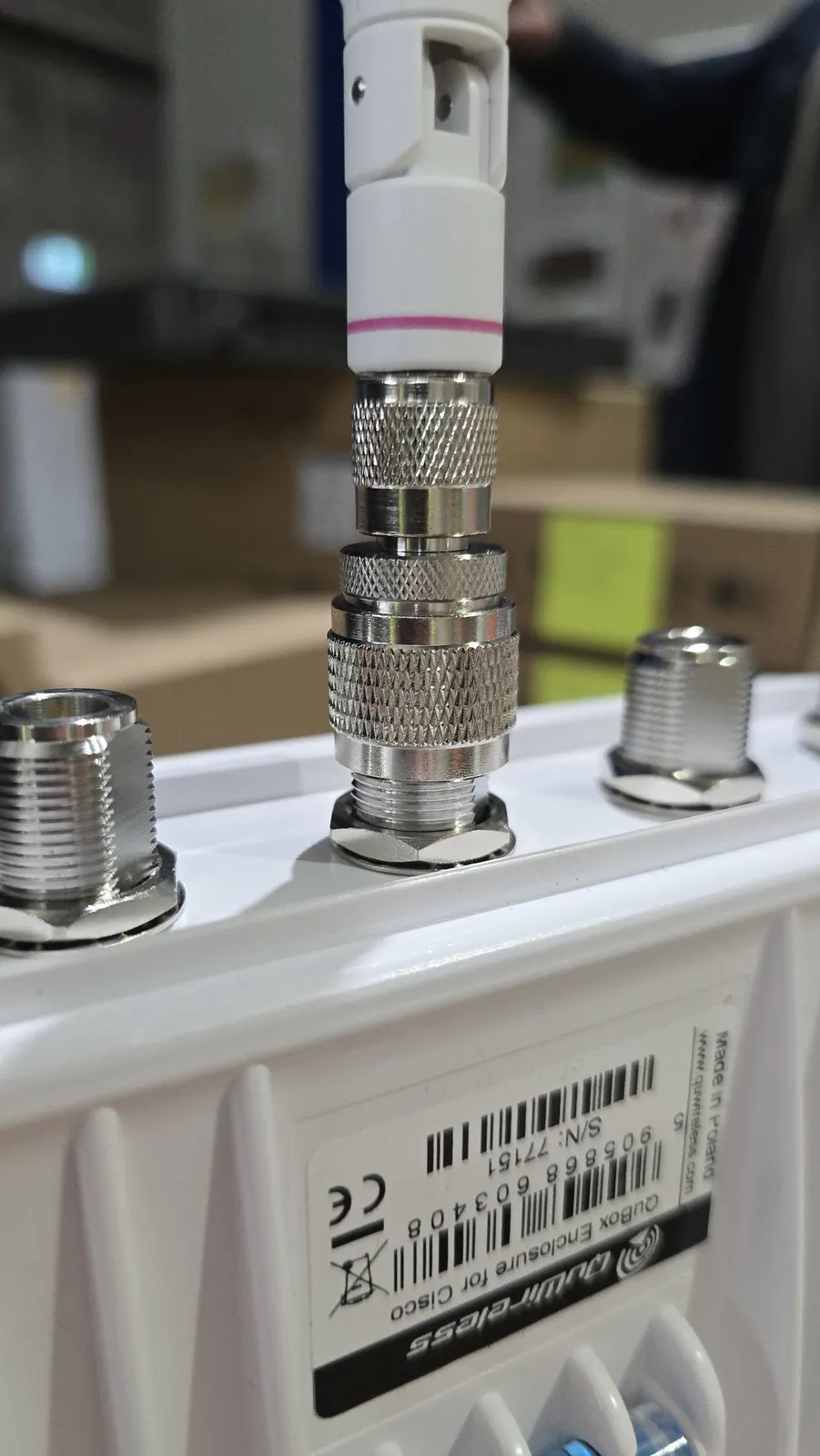
Unremarkable on its own. Categorically the same kind of thing that took two nations offline for weeks.
A repeater the size of a small car failed 144 kilometres off Samoa. A connector you could hold in one hand failed in a plant room in Sydney. Same shape of problem. Different scale of consequence.
Unremarkable on its own. Categorically the same kind of thing that took two nations offline for weeks.
Ask a room full of network engineers what the smallest physical component is they've watched bring down an entire service, and you will get a genuine argument. Not a shrug. An argument.
The reaction
That's what happened on LinkedIn a fortnight ago, after a post about a submarine cable fault off Samoa picked up 21 comments from people who actually do this for a living: submarine cable project managers, principal fibre engineers, ROV operations specialists, offshore ops supervisors. People who correct you on repeater weight to the kilogram, because it matters to them.
The debate that followed said more than the original post did.
The finding
Here's what happened. A submerged optical amplifier, a repeater, developed a fault 144 kilometres off Samoa. Niue and the Cook Islands lost proper internet because of it. The Manatua Consortium's own release ruled out anchor damage, trawling, and sabotage. Whatever went wrong, went wrong inside the system itself.
The first read on that, including my own, was: a component doing what components eventually do. Wear, not damage.
One of the commenters, a principal fibre engineer, pushed back on that specifically. A shunt fault, he pointed out, means the cable's insulation has been compromised and it's earthing into the sea. That's not wear. That's damage. Something has hit it. Which raises a harder question than the first one: if it's not external, what does that leave? Manufacturing defect, material fatigue at depth, a termination failing under load?
Nobody in that thread had a confirmed answer. That's the point. A fully-costed, professionally-run international system, and the actual cause of its failure was still genuinely unclear a week after the fault was confirmed.
Beyond submarine cable
Here's where it gets useful for anyone who isn't in undersea telecoms.
The redundancy conversation in most networks happens at the routing layer. Failover paths, diagram after diagram, all showing how traffic moves if one path drops. What that conversation almost never covers is what happens when the physical thing carrying the signal is the thing that fails, and the fix requires someone to physically go and find it.
For Manatua, that means a repair vessel, a queue of other faults competing for the same limited repair capacity, and a timeline nobody can commit to because "how long is a piece of string" was the literal answer one of the engineers gave when asked.
For a building in Sydney, it means something much smaller, but structurally identical.
Same shape, smaller scale
This is where the thread stopped being about Samoa.
Boris Siljanoski, Owner Operator/Technician at Antenna Industries, replied with this:
"1 faulty F connector when slightly disturbed brought whole MATV system down ever more annoyingly it would only fault depending what orientation the feed cable was hanging on, doing other service work disturbed it and troubleshooting it then made it work again before you got to it."
That's not a coincidence of scale. That's the same failure mode as a shunt fault on a seabed cable, just playing out in a comms cupboard instead of the Pacific. My reply to Boris was the actual thesis of this article:
"That's the same physical layer stubbornness, just a different scale, Boris. Intermittent, orientation-dependent, self-clearing before you can pin it down. Whether it's an F connector or a subsea power core, an unstable physical connection behaves the same way and hides from you the same way while you're chasing it."
Garry M., whose profile reads "Connecting operational realities," added a story from a lightning strike in Malongo Camp, Cabinda, that melted an entire equipment gateway:
"There was a spare in Luanda, Angola which id left for this eventuality. Id packed in Angola 6 months before. Was going through the redundancy process, two days before id left. A colleague messaged me on Bebo from Cabinda 2 days before my leaving date. The site was down, and had been for 2 weeks."
He'd had the foresight to leave a spare, six months earlier, for exactly this scenario. It still nearly wasn't there when it mattered, because a separate internal process had already started moving that spare somewhere else. The plan existed. It just didn't live inside the diagram anyone was tracking. As I said in reply: that's the same shape as the Manatua fault, the failure point isn't dramatic, it's a component doing what components eventually do, and the plan for it lives outside the neat diagram everyone points to.
Even the correction mid-thread made the point stronger. Peter Jamieson, Principal Engineer in Core Engineering Fibre, pushed back on my first read of the Manatua fault:
"You say it's a 'shunt fault', so that means it should/could still be operational. The insulation of the cable has been compromised and it's earthing into the sea. So it's not a component failure, the repeater hasn't failed, the cable has been damaged by something that has exposed the power core. So something has hit it."
I'll take that correction on the page too, since it's true and it sharpens the point rather than undercutting it: even the causes that don't involve a ship dragging an anchor across the seabed are still physical-world failure modes that no network diagram accounts for.
Bringing it home
Most enterprise networks have never had their physical layer traced end to end since the day it was fitted out. Ports get relabelled informally. Patch leads get moved during other work and never get put back exactly right. A PoE injector or an RF splitter sits behind a screen nobody's looked behind in years.
None of that shows up on a routing diagram. All of it is exactly the kind of thing that decides how long an outage actually lasts, because you can't fail over around a physical layer you can't locate.
The teams that handle this well aren't the ones with the most detailed failover documentation. They're the ones who can also tell you, specifically, what physical thing is most likely to go first, and where it actually is.
That's a different kind of audit to the one most businesses run. It's not asking "is our network redundant." It's asking "if the thing that fails is physical, do we already know what and where."
Related reading
This article sits alongside two others documenting the same blind spot from different angles:
Common questions
Ready when you are
We work on live, business-critical networks nationwide. One accountable partner. No disruption. Full documentation.
Making critical connectivity work - end to end.