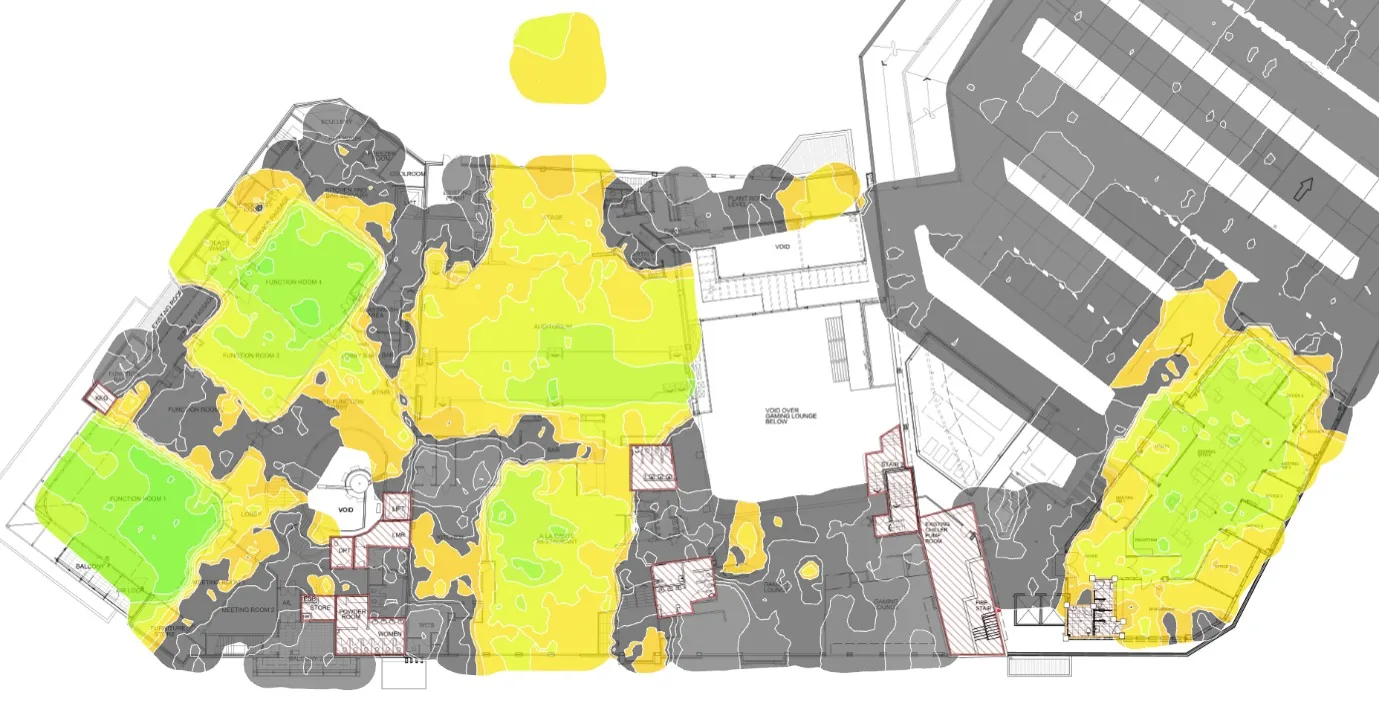
RF survey heatmap from the venue's Wi-Fi remediation project, mapping actual coverage against the club's current floor plan.
A Sydney leagues club's Wi-Fi hadn't kept up with three floors of renovations, and its below-ground gym never had coverage at all. Here's what a full RF survey found, and what it took to fix properly.
RF survey heatmap from the venue's Wi-Fi remediation project, mapping actual coverage against the club's current floor plan.
Not every coverage problem gets solved by fixing the thing that's broken. A Sydney-based leagues club, gaming floor, function rooms, a below-ground gymnasium and management offices across three floors, had two separate failures: bar and service staff losing Wi-Fi on their order tablets in parts of the venue, and zero cellular signal in the gym, deep enough underground that mobile calls simply didn't connect. The root cause wasn't a broken network. It was an outdated one.
What changed
The original Wi-Fi rollout had been designed against a floor plan that no longer existed. Gaming machines had been repositioned, bars relocated, function rooms repurposed. The venue had evolved but the access point layout hadn't moved with it. Access points that once sat exactly where they needed to were now covering the wrong areas entirely, while zones that mattered most under the current layout had never been designed for in the first place.
The gymnasium below ground was a separate gap altogether. It had never had Wi-Fi coverage at all, because it simply didn't exist as a space when the original network was built.
Why it went unnoticed
This is the trap with Wi-Fi coverage: it doesn't fail all at once when a venue changes, it just quietly stops matching where people actually are. Staff carrying tablets kept hitting dead spots in whatever part of the floor had moved furthest from the original design, and nobody connected the complaints back to a renovation that happened well before they started.
The process
A full RF survey mapped coverage against the venue as it actually operates today, not as it was originally designed. That gave a clear roadmap: where access points needed to move, where new ones were needed, and what the below-ground gym specifically required given it had never had coverage there at all.
From first survey to final post-implementation validation took three to four months, surveys, audits, reporting, a new design, club approvals, implementation, then a second RF survey to confirm the fix actually held.
The outcome
Access points were relocated and added based on the survey findings, closing the gaps affecting staff tablets across the gaming floor, function rooms and service areas. For the gym, Wi-Fi coverage was extended below ground for the first time, and staff and members now rely on Wi-Fi calling there, since mobile signal genuinely doesn't reach underground.
It's a reliable practical fix for making calls, not a solution to the underlying cellular dead zone. If a site actually needs in-building cellular coverage rather than a Wi-Fi workaround, that's a different, deliberate scope.
Our position
AAA Communications has operated as a Telstra Partner since 1992, delivering Wi-Fi design, RF surveys and capacity validation for enterprise, industrial and critical environments across Australia, including venues managing dense, mixed-use spaces like licensed clubs, gyms and function facilities.
Common questions