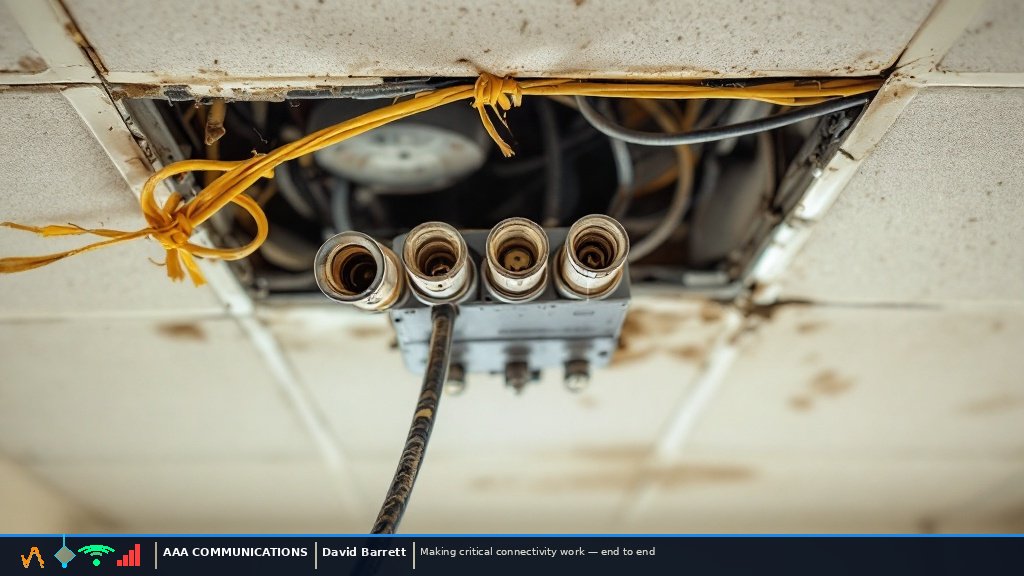
An in-building cellular splitter corroding above a ceiling tile. The 4G backup path depends on it, and nobody has looked since install.
The plan reads as two independent paths. The fixed line drops, 4G takes over, business continues. In most buildings that backup has never carried the full site under real load, and the day it has to is the worst possible day to find the weak link.
An in-building cellular splitter corroding above a ceiling tile. The 4G backup path depends on it, and nobody has looked since install.
A 4G failover line on a continuity plan is worth exactly what it delivers on the day the primary fails. Until the physical path is validated and the cutover tested under real load, it is a hope written into a document, not a control you can rely on.
Redundancy on paper
The plan looks sound. Primary fixed-line circuit, 4G or 5G failover, automatic cutover. On a network diagram it reads as two independent paths and the risk looks covered.
In the building it is often one well-maintained path and a backup that has never carried real traffic. The fixed line gets used every day, so its faults surface. The 4G path sits idle until the moment everything depends on it. Idle is not the same as ready.
A backup that has never carried the full site under load is not a control. It is an assumption written into a continuity plan and signed off as if it were proven.
Different spectrum
Your fixed connection and your 4G path fail for different reasons, and that is exactly why the backup is worth having. A fibre cut in the street does not touch a cellular signal. Genuine path diversity is the whole value.
But independence cuts both ways. The 4G path does not lean on your fibre, which means it carries its own separate chain of physical dependencies. Antennas, coax, splitters, repeaters. Most of that chain sits above a ceiling tile where nobody looks, on equipment installed years ago and never revisited.
"The backup fails for different reasons than the primary. That is the point, and it is the blind spot."
Where it breaks first
In-building cellular is not magic that arrives through the air. It depends on a physical distribution system: antennas, coaxial runs, splitters, and repeaters or a hybrid head-end. Every one of those is a component that ages, corrodes, and drifts out of spec.
Here is the imbalance. The primary fibre and copper gets tested, certified and documented. The cellular path is treated as set and forget, commissioned once and never touched again. The splitter corroding above the ceiling holds right up until the day the primary fails and the whole site cuts to 4G under full load. That is the worst possible moment to discover the weak link, because it is the one moment you cannot fall back.
A separate blind spot
Wi-Fi and in-building cellular use different spectrum, different antenna systems and different propagation patterns. Coverage that works for one tells you nothing about the other. Different dead zones, different failure points, same assumption that they align.
Operations teams know their Wi-Fi dead zones because they live with them daily. Almost nobody has mapped in-building cellular against the same floor plan. In a hospital, that gap sits under clinical communications and duress systems, where an untested assumption is a patient safety exposure, not an IT inconvenience.
Failover should be tested on a schedule, during non-productive hours, the same way you would test a generator. Carrier-by-carrier signal measurement at the locations that matter, cellular mapped against the same floor plan as your Wi-Fi, and where coverage falls short, engineered solutions, CEL-FI smart repeaters, Nextivity Quatra DAS and hybrid designs, validated across all carriers.
Coverage versus reality
Carrier coverage maps show outdoor signal strength. They are accurate for the street and meaningless for the desk. Concrete, steel, low-E glass and modern insulation all attenuate cellular signal hard before it reaches the people using it.
Two bars in the car park can be nothing at the nurses station, the warehouse floor or the back office. A backup that works at the front door and dies where the work actually happens is not a backup. The only number that matters is the signal where your people are, measured, not assumed.
The test that counts
Failover tested with one laptop is not failover tested. A single device proves the path lights up. It proves nothing about what happens when the entire site cuts across at once.
Under full cutover, throughput, contention and latency all change. A path that looks fine carrying one connection can collapse carrying two hundred. The test that counts is the full cutover, run deliberately on a quiet afternoon, watched and measured. The alternative is discovering the answer accidentally, in the middle of an outage, with the whole business waiting.
Our position
We have been validating physical infrastructure under real-world demand since 1992. The 4G or 5G failover is a sound idea. Treating it as proven before it has ever carried the site is the problem. The cellular path degrades quietly, exactly like the primary does, except nobody is watching it because it is not in daily use.
A Layer 1 audit validates the physical cellular path end to end, measures in-building signal where your people actually work, and tests cutover under real load. Where the answer is stronger in-building coverage, our in-building 4G and 5G coverage work covers design, distribution and validation for all carriers.
Physical audit of the cellular path: antennas, coax, splitters and repeaters. In-building signal measurement where people work, not at the front door. Full failover test under real load. As-built documentation that matches reality. One accountable partner, nationwide, on live business-critical networks.
Common questions
Validate the physical cellular path, measure in-building signal where it matters, and prove cutover under real load, on your terms.
Validate Your 4G Backup