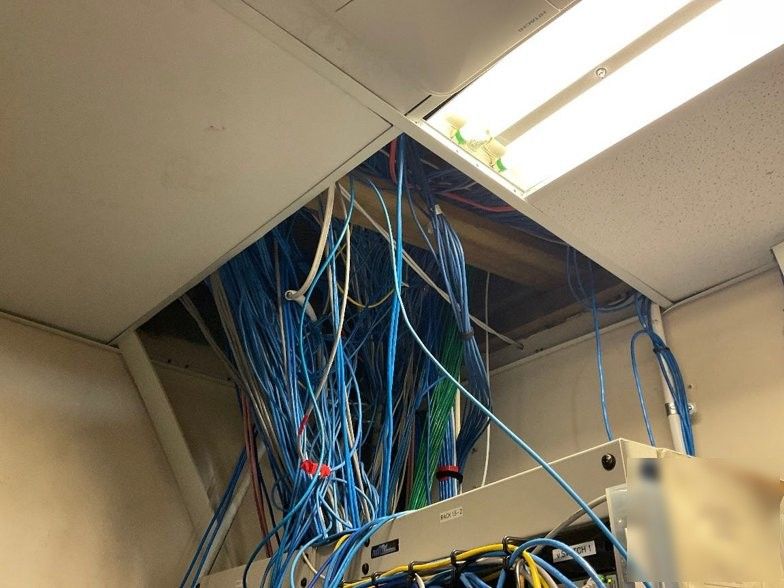
Actual field photograph. Commercial site, Australia. The cabling a new access point inherits is rarely the cabling its uplink port was designed for.
Wi-Fi 6 access points ship with 2.5 Gbps uplink ports because 1 Gbps became the constraint. In a lot of buildings, what's actually run to the AP is Cat5e installed before multi-gigabit wireless was a design requirement. The air interface isn't the limit anymore. The cable is.
Actual field photograph. Commercial site, Australia. The cabling a new access point inherits is rarely the cabling its uplink port was designed for.
A Wi-Fi 6 access point goes in. Procurement's happy, the AP's rated for gigabit-plus speeds, the project's marked complete. Then performance falls short, and the investigation starts everywhere except the cable in the wall.
Why the AP isn't the constraint
Wi-Fi 6 access points ship with 2.5 Gbps uplink ports. That's not a spec sheet flourish, it's an admission. The industry already knows 1 Gbps is the bottleneck for an AP aggregating a full floor of concurrent clients. The air interface stopped being the limiting factor years ago. What's limiting it now is whatever's actually run to the AP.
And in a lot of sites, what's run to the AP is Cat5e cabling installed before multi-gigabit wireless was anyone's design requirement, because at the time, it didn't need to be.
A faster AP doesn't reduce what's demanded of the cabling underneath it. It raises the bar the cabling has to clear. New technologies increase dependence on Layer 1, they don't reduce it.
Where it actually breaks
This is worth being precise about, because the loose version of it doesn't hold up, and we know that, because the LinkedIn post this article is based on was tested by exactly the engineers who'd know.
Healthy, short-run Cat5e can do 1 Gbps fine, and sometimes 2.5 Gbps over shorter distances. That's not in dispute. The failure mode isn't "Cat5e is incapable of gigabit." It's two separate things stacking on top of each other.
Nothing fails outright. It's just degraded enough that nobody's looking at the cable as the cause.
"The bottleneck didn't disappear when the AP was upgraded. It moved into the wall and stopped announcing itself."
The diagnostic blind spot
This is the pattern that shows up site after site: hardware budget gets approved, APs go in, performance falls short of what the spec sheet promised, and the response is always pointed at the active layer. RF planning. Placement. Channel overlap.
The physical layer doesn't get checked because nobody's trained to suspect it first. The AP is new, the configuration is reviewable, the RF environment is measurable. The cable in the wall is none of those things to most of the people troubleshooting the fault, so it's the last thing checked instead of the first.
Risk isn't old technology, it's undocumented, unvalidated infrastructure. If you haven't had the horizontal cabling validated against current standards, the Wi-Fi 6 mismatch is rarely the only thing waiting to surface.
How to action it
If you're running this audit across a multi-closet site, don't try to replace everything at once. That's not a fundable proposal and it won't get approved as one. Treat it as a per-closet sequence instead.
This is the same diagnostic gap that shows up across most brownfield LAN environments: undocumented changes, untested runs, and infrastructure inherited from a previous design era.
What the thread confirmed
When this went up on LinkedIn it didn't just get views. It drew principal systems engineers, senior network engineers, and data centre operations leads into a working debate: some confirming the pattern on their own live sites, some pushing back on the specifics. The thesis held up, but it held up because the pushback sharpened it, not because nobody disagreed.
If a claim about infrastructure risk can survive credentialed engineers testing it in public, that's a stronger signal than a claim nobody's challenged.
Our position
We've been validating physical infrastructure since 1992. What changes is the load being placed on cabling that was never designed to carry it, and the cost when someone finally discovers the gap between what the AP needs and what the cable can deliver.
A Layer 1 audit identifies the mismatch before it's misdiagnosed as RF: cable identification, certification testing against current standards, PoE load and run-length assessment, and as-built documentation that reflects what's actually in the wall.
Full physical audit of the installed cabling. Certification testing, run-length and PoE+ load assessment, pathway mapping. Remediation scoped and sequenced against budget cycles. One accountable partner. Nationwide delivery on live, business-critical networks.
If the problem is confined to one room or area rather than the whole site, Fix the Wi-Fi Problem Zone surveys just that space, makes agreed adjustments, and gives you before/after results.
Planning a Wi-Fi 7 upgrade? The same logic applies to power. Check the switch budget and patch leads before you order. Wi-Fi 7 AP audit from A$749 ex GST, written report in 5 business days.
Common questions
Yes. Wi-Fi 6 access points commonly ship with 2.5 Gbps uplinks. Most Cat5e was never rated for that aggregate load, so the access point is capped by the cable underneath it, not the wireless spec.
Check the switch port speed the AP is actually negotiating against the AP's rated uplink. If it's capped well below 2.5 Gbps, that's a cable spec ceiling, not interference. It's commonly misdiagnosed as RF because the symptoms look similar.
Not necessarily. An audit identifies exactly which runs are the bottleneck so remediation can be targeted to AP locations that need it, not the whole floor.
Cat6A is the safe baseline for full 2.5 Gbps and above uplinks. Existing Cat6 can work in some cases depending on run length and certification, but Cat5e is the most common bottleneck we find.
Before the next AP refresh goes in, validate what the cabling underneath it can actually carry.
Book a Layer 1 Assessment